
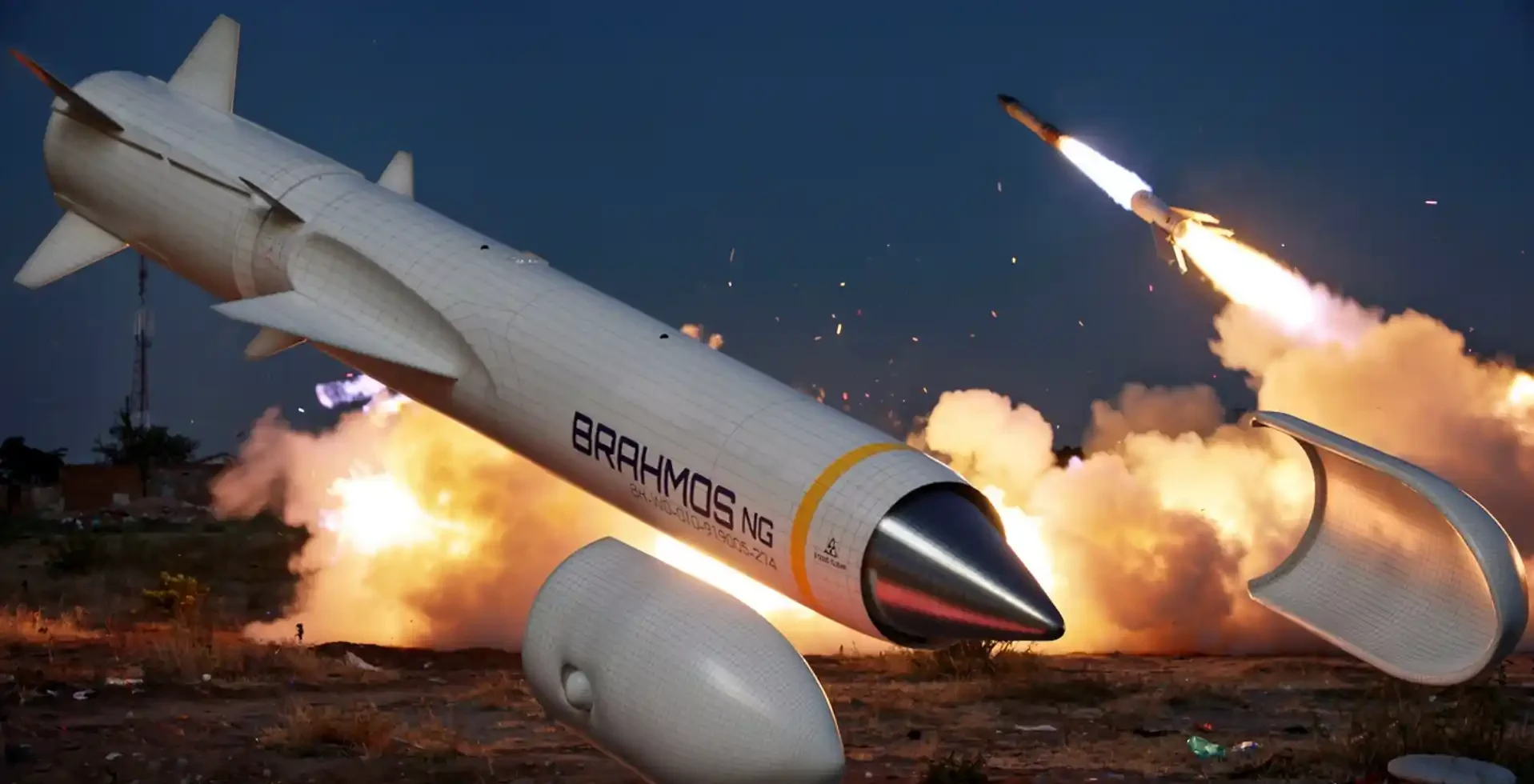
India is rapidly strengthening its defence technology, and one of the most exciting developments is the BrahMos-NG missile program. This next-generation supersonic cruise missile is designed to be lighter, faster, smarter, and more powerful than the original BrahMos missile.
With advanced AESA seeker technology, fighter jet compatibility, and multi-platform launch capability, it is expected to play a major role in future warfare. Defence experts believe this advanced missile system can significantly boost India’s air power, naval strength, and precision-strike capability, while also strengthening India’s position in the global defence export market.
What is BrahMos-NG?
BrahMos-NG stands for BrahMos Next Generation missile. It is the compact and advanced version of the original BrahMos missile jointly developed by India and Russia.
The primary objective behind this new missile system is to:
- Reduce weight
- Improve operational flexibility
- Increase aircraft compatibility
- Enhance strike precision
- Improve battlefield survivability
The earlier BrahMos missile was extremely powerful but also very heavy. Because of this limitation, only larger aircraft like the Su-30MKI could carry it effectively.
The compact structure of the next-generation variant solves this challenge.
Key Features of the Missile
Compact and Lightweight Design
One of the biggest advantages of BrahMos-NG is its smaller size and lighter structure.
Expected Specifications
| Feature | Details |
|---|---|
| Length | Around 6 meters |
| Weight | Around 1.5 tons |
| Speed | Mach 3.5 |
| Range | 290+ km |
| Guidance | AESA seeker |
| Launch Platforms | Air, sea, land, submarine |
The reduced weight allows fighter aircraft to carry multiple missiles, significantly increasing strike capability.
When does the autonomous testing of BrahMos-NG actually start? Read here for more information.
Why This Missile is Important for India
The development of BrahMos-NG is strategically important for India’s future military capability.
Enhanced Air Strike Capability
Indian fighter jets can launch long-range precision attacks while remaining safer from enemy air defence systems.
Strong Naval Warfare Capability
Warships and submarines can destroy enemy vessels quickly during maritime combat situations.
Multi-Platform Launch Flexibility
The missile can launch from:
- Fighter aircraft
- Mobile launch vehicles
- Naval destroyers
- Submarines
This makes the weapon system highly flexible during modern warfare.
Faster Battlefield Deployment
The compact design makes transportation and deployment easier and faster.
Fighter Aircraft Integration
One major reason behind the global attention around BrahMos-NG is its compatibility with several advanced fighter jets.
Aircraft Expected to Carry the Missile
Sukhoi Su-30MKI
India’s frontline air superiority fighter aircraft.
HAL Tejas Mk1A
India’s indigenous light combat aircraft.
HAL Tejas Mk2
India’s future medium-weight fighter platform.
Dassault Rafale
An advanced multi-role fighter aircraft currently serving in the Indian Air Force.
AMCA
India’s future fifth-generation stealth fighter aircraft.
The older missile variant could not integrate easily with several aircraft because of weight limitations. This next-generation version changes that completely.
Advanced AESA Seeker Technology
One of the most important upgrades in BrahMos-NG is the integration of advanced AESA seeker technology.
What is AESA?
AESA stands for:
Active Electronically Scanned Array
This advanced radar guidance system significantly improves target detection and strike accuracy.
Advantages of AESA Technology
- Faster target identification
- Better resistance against electronic jamming
- Improved tracking of moving targets
- Higher strike precision
- Better combat survivability
This technology makes the missile smarter and more effective during high-intensity warfare.
Speed and Strike Capability
Speed remains one of the deadliest strengths of this supersonic cruise missile.
The missile is expected to travel at:
Mach 3.5 Speed
This means it can fly more than three times faster than the speed of sound.
Why High Speed Matters
- Enemy defence systems get very little reaction time
- Missile interception becomes extremely difficult
- Faster target destruction
- Improved battlefield dominance
Many countries still rely on slower subsonic cruise missiles, giving India a major tactical advantage.
How the Missile Works
Understanding the operational process helps beginners understand the technology more clearly.
Step 1: Target Identification
Enemy targets are identified using radar systems, satellites, or surveillance platforms.
Step 2: Missile Launch
The missile launches from aircraft, submarines, warships, or mobile launch systems.
Step 3: Booster Acceleration
The booster rapidly accelerates the missile to supersonic speed.
Step 4: Cruise Flight
The missile continues flying toward the target at an extremely high speed.
Step 5: Terminal Guidance
The AESA seeker locks onto the target with high precision.
Step 6: Precision Strike
The missile hits the target with strong destructive capability.
Why the World is Closely Watching This Program
Many defence experts believe this advanced missile system can become one of the most dangerous precision strike weapons in modern warfare.
Main Reasons
- Extremely high speed
- Precision strike capability
- Sea-skimming attack profile
- Difficult interception
- Multi-platform launch flexibility
- Advanced guidance systems
These capabilities make the missile highly effective against enemy naval and strategic targets.
Comparison With the Original BrahMos Missile
| Feature | Original Version | Next-Generation Variant |
|---|---|---|
| Weight | Around 3 tons | Around 1.5 tons |
| Length | 8.4 meters | Around 6 meters |
| Aircraft Compatibility | Limited | Much wider |
| Guidance | Older technology | AESA seeker |
| Operational Flexibility | Moderate | Very high |
The newer version is designed specifically for future warfare requirements.
Comparison With Other Global Missiles
BrahMos-NG vs Tomahawk Missile
| Feature | Indian Missile | Tomahawk |
|---|---|---|
| Speed | Mach 3.5 | Subsonic |
| Strike Time | Faster | Slower |
| Launch Flexibility | Multi-platform | Mainly naval |
BrahMos-NG vs Chinese YJ-12
| Feature | Indian System | YJ-12 |
|---|---|---|
| Guidance | AESA seeker | Different radar system |
| Operational Flexibility | High | Moderate |
| Export Potential | Growing | Limited |
Submarine Launch Capability
India is also planning a submarine deployment capability for BrahMos-NG.
Benefits of Underwater Launch Capability
- Surprise attack capability
- Long-range precision strikes
- Strong maritime deterrence
- Improved underwater warfare capability
Future Indian submarines may use vertical launch systems and torpedo launch systems for deployment.
Latest Updates in 2026
Several important developments are currently progressing.
Recent Developments
- Advanced testing activities are ongoing
- Fighter aircraft integration work continues
- AESA seeker development is progressing
- Production infrastructure is expanding
- Export discussions are increasing
Countries Showing Interest
- Indonesia
- Vietnam
- Philippines
This highlights India’s growing influence in the global defence export market.
Read More: India Nears $700 Million BrahMos Missile Deal with Vietnam—Indonesia Next?
Explore: India Sends 2nd Batch of BrahMos Missiles to the Philippines in $375M Deal
Expert Analysis
Military experts believe BrahMos-NG can become one of India’s most important tactical weapons because of its portability, speed, and compatibility with multiple fighter aircraft.
Its compact design allows broader deployment without reducing strike capability. Defence analysts also believe this missile program can become a major export success for India in the future.
Challenges Ahead
Although the project looks highly promising, several challenges remain.
Major Challenges
- Large-scale production
- Aircraft integration testing
- Cost optimisation
- Export approvals
- Advanced seeker refinement
However, India has already shown major progress in indigenous missile development over the last decade.
Future of India’s Next-Generation Missile Program
The future looks extremely powerful for this advanced defence project.
Experts believe it may become:
- The backbone of India’s precision strike capability
- A major naval warfare weapon
- A globally demanded export system
- A strong military deterrence platform
The rise of BrahMos-NG clearly shows that India is entering a new era of advanced military technology.
Frequently Asked Questions
Q1. What is the speed of BrahMos-NG?
Ans: The missile is expected to travel at Mach 3.5 speed.
Q2. Which aircraft can carry this missile?
Ans: Su-30MKI, Rafale, Tejas Mk1A, Tejas Mk2, and AMCA are expected to integrate it.
Q3. Is it a hypersonic missile?
Ans: No. It belongs to the supersonic cruise missile category.
Q4. What is the expected range?
Ans: The expected range is more than 290 km.
Q5. Why is this missile important for India?
Ans: It strengthens India’s air power, naval warfare capability, and defence export potential.
Conclusion
The development of BrahMos-NG represents far more than another missile system. It reflects India’s ambition, innovation, technological capability, and military confidence.
With its compact design, Mach 3.5 speed, advanced AESA seeker, fighter jet compatibility, submarine launch capability, and precision strike capability, this next-generation weapon system is expected to redefine modern warfare.
India is no longer only purchasing advanced defence systems from foreign nations. Today, the country is building world-class military technology capable of competing with the strongest global powers.
This missile program stands as a symbol of India’s growing strength, self-reliance, and future dominance in advanced defence technology.