
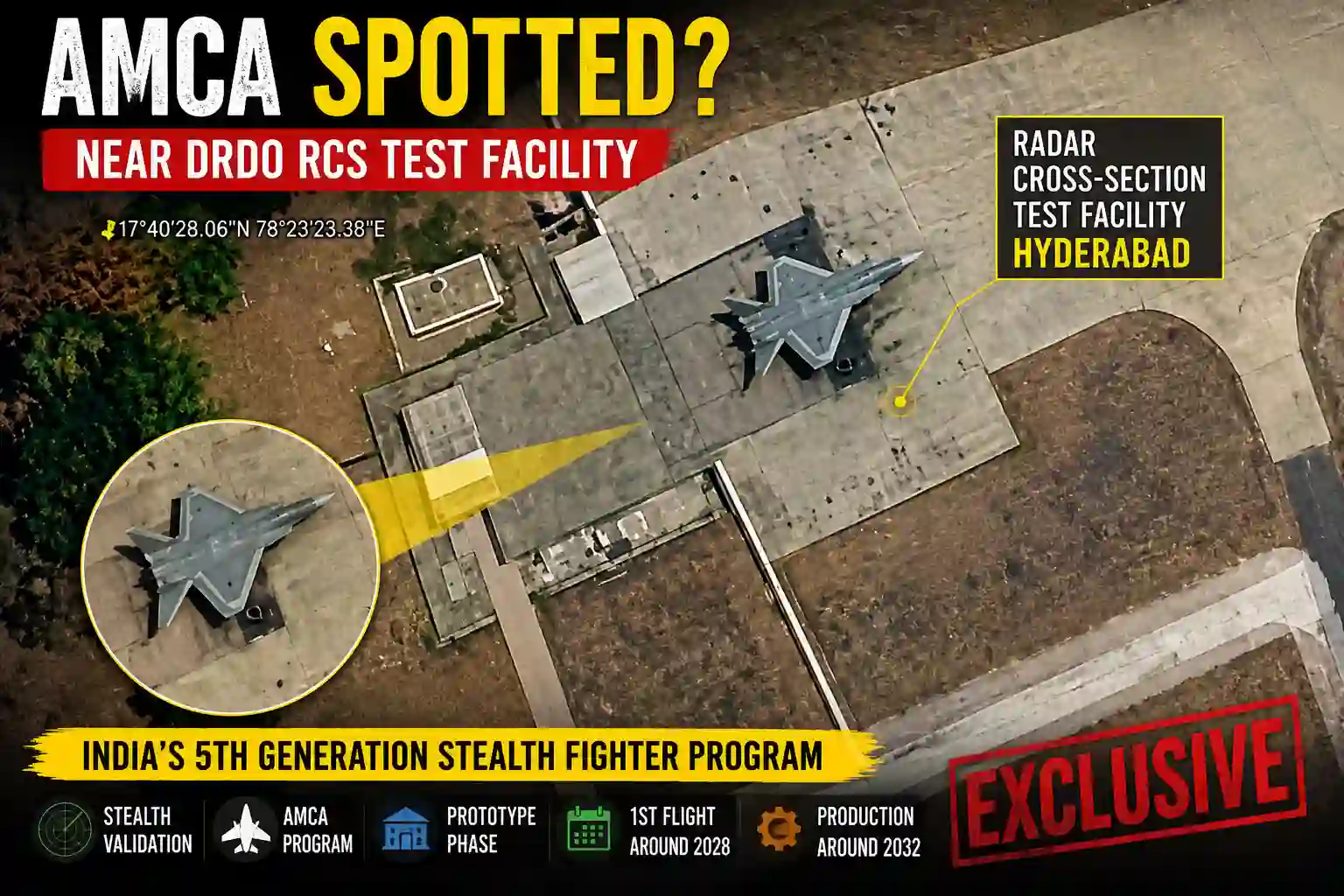
Fresh satellite images showing what many analysts believe could be an AMCA stealth fighter structure near a sensitive DRDO-linked Radar Cross-Section (RCS) testing facility in Hyderabad have triggered massive discussion across defence circles and social media.
While DRDO has not officially confirmed the reports, the latest AMCA spotted claims are already being viewed as a potentially major moment in India’s fifth-generation fighter ambitions. Experts believe the reported sighting may indicate that the Advanced Medium Combat Aircraft (AMCA) program is entering deeper stealth validation stages — a critical phase before prototype development, flight trials, and eventual operational deployment in the coming decade.
AMCA Quick Facts
- Aircraft Type: Fifth-generation stealth fighter
- Developer: ADA, DRDO, Private Companies
- Testing Focus: Radar Cross-Section (RCS) validation
- Engine (Initial): GE F414
- Expected First Flight: Around 2028
- Estimated Production Timeline: Around 2032
- Role: Air superiority and deep strike missions
- Current Stage: Stealth validation and prototype preparation
What Is the AMCA Program?
The Advanced Medium Combat Aircraft (AMCA) is India’s planned indigenous fifth-generation stealth fighter aircraft being developed by the Aeronautical Development Agency (ADA) in collaboration with DRDO and Hindustan Aeronautics Limited (HAL).
The aircraft is expected to provide:
- Advanced stealth capability
- Internal weapons bays
- Sensor fusion systems
- Electronic warfare capability
- AI-assisted combat systems
- Long-range strike capability
- Air superiority dominance
Once operational, the AMCA program is expected to place India among a select group of nations capable of building indigenous stealth fighter aircraft.
For many Indians following the developments closely, the AMCA represents far more than just another fighter jet — it symbolises decades of indigenous aerospace ambition and technological self-reliance.
AMCA Spotted Near Radar Cross-Section Testing Facility
According to multiple defence observers, the latest AMCA spotted images allegedly show a full-scale engineering model positioned near a Radar Cross-Section (RCS) testing facility associated with DRDO’s aerospace ecosystem in Hyderabad.
The structure reportedly includes several stealth-oriented design elements such as:
- Diverterless Supersonic Intakes (DSI)
- Canted twin vertical stabilisers
- Serrated stealth edges
- Internal weapons bay shaping
- Blended fuselage geometry
- Reduced radar signature contours
The timing of these reports has significantly increased public curiosity because RCS testing is considered one of the most important phases in stealth aircraft development.
Many defence analysts believe the aircraft structure may not yet be a flyable prototype but rather an advanced engineering mock-up used for stealth signature validation.
But stealth validation itself is only one part of a much larger and technically demanding development process.
Why RCS Testing Is So Important
Radar Cross-Section (RCS) testing determines how detectable an aircraft is on enemy radar systems.
Stealth aircraft are specifically designed to reduce radar reflections using specialised shaping, materials, angles, and heat-management systems.
Even very small changes in aircraft geometry can affect stealth performance. During RCS testing, engineers study how radar waves interact with the aircraft under different conditions.
During RCS testing, engineers typically evaluate:
- Radar reflection patterns
- Surface angles and shaping
- Air intake visibility
- Weapons bay signature exposure
- Infrared and heat signatures
- Electromagnetic emission levels
- Multi-frequency radar detection probabilities
This is why the sighting of the reported AMCA near the RCS testing facility has generated strong reactions among defence experts.
For many observers, it indicates that the program may be progressing beyond conceptual development and entering deeper stealth optimisation stages before actual prototype flight testing begins.
What Happens After RCS Testing?
Many casual readers assume that once stealth testing starts, the aircraft is almost ready.
However, fifth-generation stealth fighter development is an extremely long and technically demanding process involving years of testing and refinement.
According to aerospace experts, RCS testing is only one phase among dozens of validation processes required before operational deployment.
After RCS testing, the AMCA program may still undergo:
- Aerodynamic testing
- Structural stress validation
- Engine integration trials
- Flight control software testing
- Avionics integration
- Sensor fusion calibration
- Weapons integration testing
- Electronic warfare validation
- Taxi trials
- Supersonic performance evaluation
- Extreme weather testing
- Flight safety certification
- Combat survivability testing
Defence analysts believe India could eventually build around five AMCA prototypes for different testing requirements before final production approval.
Different prototypes are usually developed for:
- Structural testing
- Flight testing
- Weapons testing
- Avionics validation
- Stealth refinement
- Certification trials
And even after successful prototype validation, the aircraft would still need years of flight testing before entering operational service.
First Flight Timeline and Production Expectations
Several earlier reports have indicated that the first AMCA prototype flight could potentially take place around 2028 if development timelines remain on track.
After the maiden flight, the aircraft will likely undergo years of intensive testing, systems refinement, and certification activities before entering operational service.
The expected development roadmap may include:
| Stage | Expected Timeline |
|---|---|
| RCS & stealth validation | Ongoing |
| Prototype manufacturing | 2026–2028 |
| First flight testing | Around 2028 |
| Advanced flight trials | 2028–2031 |
| Weapons & systems certification | 2029–2031 |
| Initial production phase | Around 2032 |
Experts caution that timelines in stealth fighter programs frequently evolve because of the enormous technical complexity involved.
Still, the latest AMCA spotted reports suggest that India’s indigenous stealth fighter program may now be steadily moving toward the prototype era.
Read More: AMCA Project Timeline: Milestones of India’s Stealth Fighter
Why Hyderabad Matters in India’s Defence Ecosystem
Hyderabad remains one of India’s most important defence and aerospace hubs.
The region hosts several strategic DRDO laboratories involved in:
- Missile development
- Radar systems
- Electronic warfare
- Aerospace engineering
- Advanced materials research
- Stealth technology development
Due to this ecosystem, the AMCA reported near Hyderabad has gained increased attention from military analysts.
Many believe the location itself strongly indicates that advanced stealth-related testing activities may already be underway behind closed doors.
Explore: Inside AMCA Weapons Bay Door Actuation System
Why the World Is Watching the AMCA Program
Military analysts worldwide are closely watching the AMCA stealth fighter program because stealth fighter development remains one of the most difficult aerospace challenges in modern warfare.
Only a handful of countries currently operate indigenous fifth-generation fighter aircraft, making India’s progress strategically significant for the global defence landscape.
The project also comes at a time when countries such as the United States, China, Russia, and Turkey are accelerating next-generation air combat programs and future air dominance technologies.
In this environment, the AMCA could become one of India’s most important long-term military aviation projects.
What Is Officially Confirmed — And What Remains Speculation?
One of the biggest reasons the story has gone viral is that multiple narratives are circulating online.
While several satellite-image analysts and defence enthusiasts believe the AMCA spotted reports are genuine, official confirmation remains limited.
Officially Confirmed:
- India has approved AMCA prototype development
- DRDO, ADA, and HAL are actively working on the project
- Stealth fighter infrastructure expansion is underway
- AMCA is intended to become India’s first indigenous fifth-generation fighter
Not Officially Confirmed:
- The exact identity of the spotted structure
- Whether the structure is a prototype or an engineering mock-up
- Exact RCS testing details
- Final production timelines
- Exact first-flight schedule
Satellite imagery analysis alone cannot independently confirm the exact status of classified military programs.
Defence experts also advise caution regarding exaggerated online claims until official statements are released.
The Bigger Picture Behind the AMCA Spotted Reports
Whether the reported AMCA spotted near the DRDO-linked RCS testing facility is a full prototype, stealth validation model, or advanced engineering mock-up, the growing evidence points toward one clear reality — India’s stealth fighter ambitions are steadily moving forward behind closed doors.
The road ahead remains long.
Even after RCS testing, the aircraft will still need years of engineering refinement, prototype validation, flight trials, systems certification, and operational evaluation before entering full-scale production.
However, for many defence observers, the latest developments indicate that the AMCA program is no longer just a conceptual vision displayed at defence exhibitions.
It is gradually evolving into a real operational platform that could shape the future of India’s aerial warfare capability for decades to come.
For now, official silence continues.
But if the latest AMCA spotted reports are even partially accurate, India’s stealth fighter journey may already be entering a phase the world can no longer ignore.