
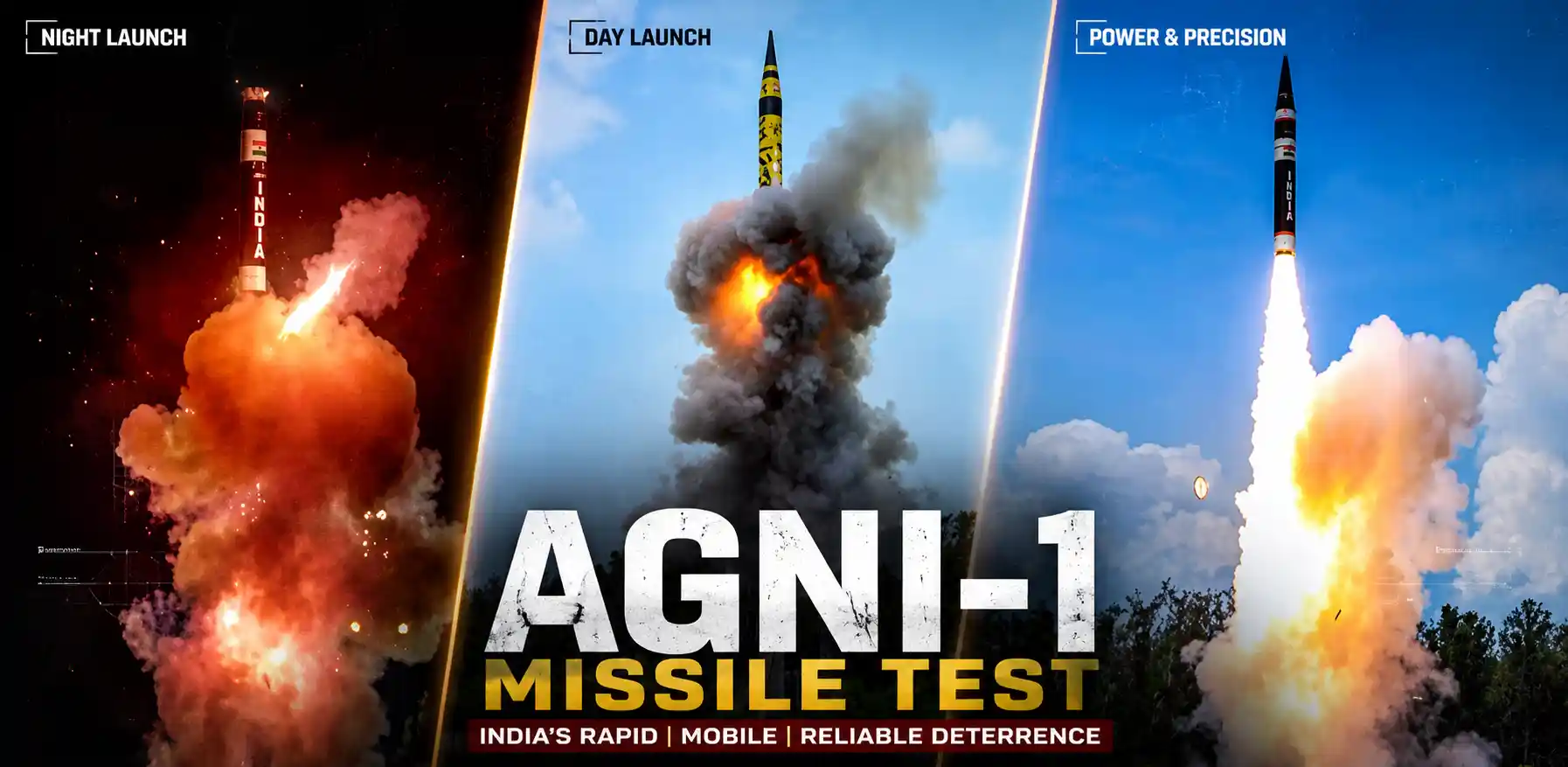
India successfully conducted the latest Agni-1 missile test on May 22, 2026, at the Integrated Test Range in Chandipur, Odisha.
Conducted under the supervision of the Strategic Forces Command (SFC), the launch once again confirmed the operational reliability of India’s short-range ballistic missile designed for rapid nuclear deterrence and battlefield response.
The test comes amid rising military competition across Asia, with China and Pakistan rapidly expanding their missile capabilities. Just weeks after India tested Agni-5 with advanced MIRV technology, the latest Agni-1 missile test shows India is strengthening both long-range nuclear deterrence and rapid battlefield response capability simultaneously.
Defence experts believe Agni-1 remains a key part of India’s strategic missile network because of its mobility, quick-launch capability, and operational flexibility during conflict situations.
Why Is India Testing Agni-1 Again If It Is Already Operational?
A major question after the latest launch is why India continues testing Agni-1 despite the missile already serving in the country’s strategic forces for years.
The latest Agni-1 missile test was not meant to showcase a new missile system. Instead, the launch focused on verifying:
- Deployment reliability,
- Missile performance,
- Launch coordination,
- And a rapid response capability under operational conditions.
Strategic weapons cannot remain unused for long periods without validation. Defence experts say periodic operational tests ensure:
- Launch crews remain prepared,
- Missile systems continue functioning properly,
- And command networks operate smoothly during emergencies.
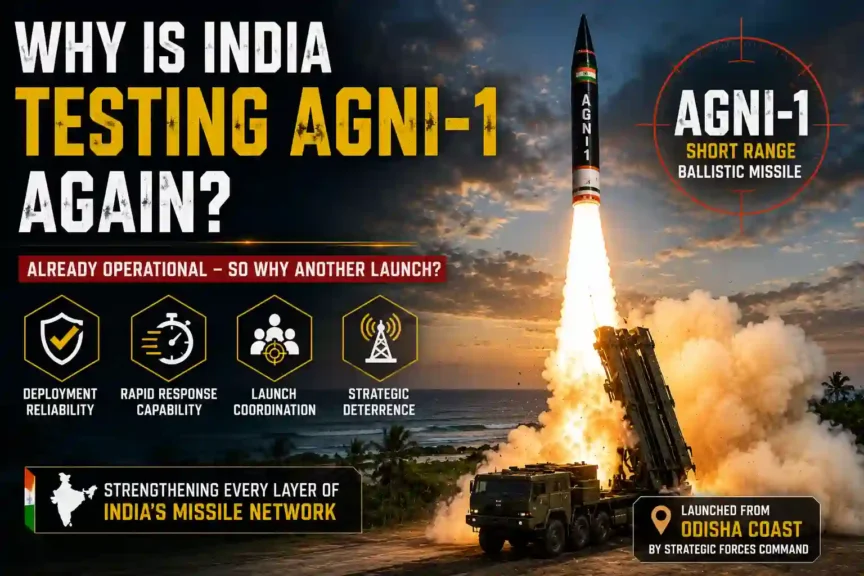
The latest launch also carried a broader strategic message. By conducting another successful Agni-1 missile test in 2026, India showed that even older missile systems continue to remain reliable and operational despite the rapid development of newer technologies.
Some defence analysts also believe the launch may have been used to validate upgraded electronics, navigation systems, or deployment procedures, although official technical details remain classified.
What Happened During the Latest Agni-1 Missile Test?
The missile launch was conducted from Odisha’s eastern coast as part of an operational readiness exercise. According to defence officials, the missile accurately followed its planned flight path and achieved all mission objectives.
The launch focused on assessing the missile’s battlefield deployment capability, highlighting the advancements and reliability of India’s indigenous missile program over the years.
Key Highlights of the Missile Test
| Feature | Details |
|---|---|
| Missile Type | Short-range ballistic missile |
| Range | Approximately 700–900 km |
| Capability | Conventional and nuclear warheads |
| Fuel Type | Solid-fuel propulsion |
| Launch Platform | Mobile road launcher |
| Developed By | DRDO |
| Operated By | Strategic Forces Command |
The successful launch validated:
- targeting accuracy,
- rapid launch capability,
- system reliability,
- and field deployment preparedness.
The test also reinforced India’s growing focus on maintaining a strategically active missile force.
Why the Agni-1 Missile Still Matters in 2026
Many people focus mainly on long-range systems like Agni-5. However, modern warfare depends on a layered missile network where short-range and medium-range systems remain equally important.
With its operational range and rapid launch capability, Agni-1 remains one of India’s most effective missile systems for regional deterrence and battlefield preparedness.
Fast Battlefield Response
One of Agni-1’s biggest strengths is its solid-fuel propulsion system. Unlike liquid-fuel missiles that require longer preparation before launch, solid-fuel systems can be activated much faster during emergencies.
This gives India:
- faster strategic response capability,
- improved battlefield flexibility,
- and stronger survivability during conflict.
Strong Regional Deterrence
Agni-1 was designed mainly for regional strategic deterrence. Its operational range makes it highly effective for nearby strategic targets during military escalation scenarios.
This ensures India maintains credible deterrence without depending entirely on intercontinental-range systems. The latest launch also highlighted how important short-range missile systems remain in modern conflict planning.
Why This Missile Test Is Strategically Important Right Now
The timing of the launch is extremely important. Asia is currently witnessing:
- rapid military modernisation,
- growing missile stockpiles,
- increasing nuclear competition,
- and rising geopolitical tension.
The latest missile launch sends a clear message that India’s strategic deterrence capability remains fully operational and mission capable.
China’s Expanding Missile Power
China has significantly increased investments in:
- long-range ballistic missiles,
- hypersonic weapons,
- advanced nuclear systems,
- and strategic missile infrastructure.
This has increased strategic pressure across the Indo-Pacific region.
Pakistan’s Tactical Nuclear Strategy
Pakistan continues developing:
- battlefield nuclear weapons,
- short-range missile systems,
- and tactical strike capability.
India is actively enhancing its rapid-response missile systems, such as the Agni-1, to bolster regional deterrence capabilities. This latest launch has sparked renewed conversations about the intensifying missile rivalry between India and Pakistan.
How Agni-1 Strengthens India’s Defence Strategy
India adopts a policy of credible minimum deterrence, which means the country maintains sufficient strategic capability to deter aggression without unnecessary escalation.
Mobile Launcher Advantage
Agni-1 operates from road-mobile launch platforms, making it difficult for enemy surveillance systems to track deployment locations.
This improves survivability because:
- launch units can relocate quickly,
- enemy targeting becomes more difficult,
- and strategic assets remain protected during conflict.
Flexible Strategic Role
Agni-1 acts as a bridge between:
- tactical battlefield systems,
- and long-range strategic missiles.
This gives India greater flexibility during different conflict situations and strengthens the country’s broader missile deterrence strategy.
Why Agni-1 Matters for the Indian Armed Forces
Although operated by the Strategic Forces Command, the missile ecosystem strengthens India’s overall defence posture.
Importance for the Indian Air Force
Ballistic missiles reduce dependence on aircraft-based nuclear strike missions during high-risk combat operations.
This provides:
- faster strike capability,
- reduced pilot exposure,
- and improved survivability during enemy air defence scenarios.
Strengthening India’s Nuclear Triad
India’s nuclear doctrine depends on a complete nuclear triad, including:
- land-based missiles,
- air-delivered weapons,
- and submarine-launched systems.
Agni-1 strengthens the land-based component of this strategic structure and supports India’s broader nuclear deterrence strategy.
Understanding India’s Agni Missile Family
Many readers also want to understand how each missile in the Agni series serves a different strategic role within India’s defence structure.
Agni-1
A short-range ballistic missile focused on rapid-response battlefield deterrence and operational flexibility.
Agni-2
A medium-range missile that significantly expanded India’s regional strike capability.
Agni-3
Designed for heavier payloads and stronger long-range strategic operations.
Agni-4
Introduced improved guidance systems, better accuracy, and enhanced operational capability.
Agni-5
India’s most advanced operational long-range ballistic missile with canister launch capability and future MIRV integration potential.
India also achieved a major strategic milestone in 2025 with the successful Agni Prime rail-launched missile test, highlighting the country’s growing focus on mobile and rapid-response missile deployment capability.
Read More: Agni 5 Missile Test 2025: India’s Bold 5,000 km Power Move.
Hidden Strategic Message Behind the Launch
One detail many defence blogs miss is that India is not simply developing futuristic missile systems while ignoring older operational platforms.
The latest Agni-1 missile test proves India is strengthening every layer of its missile network simultaneously — from battlefield deterrence systems to advanced long-range strategic platforms.
This layered approach gives India:
- stronger operational flexibility,
- faster response capability,
- and better strategic survivability during conflict situations.
That is what makes this launch more important than a routine missile test and one of the most significant recent developments in India’s evolving missile strategy.
Conclusion
The successful Agni-1 missile test on May 22, 2026, confirmed that India’s short-range nuclear missile capability remains reliable, mobile, and fully operational during strategic deployment scenarios.
At a time of growing military competition across Asia, the launch demonstrated India’s commitment to maintaining a balanced and active strategic deterrence network.
While advanced systems like Agni-5 represent the future of India’s missile programme, Agni-1 continues to play a vital role in rapid-response deterrence, battlefield preparedness, and long-term national security strategy.