
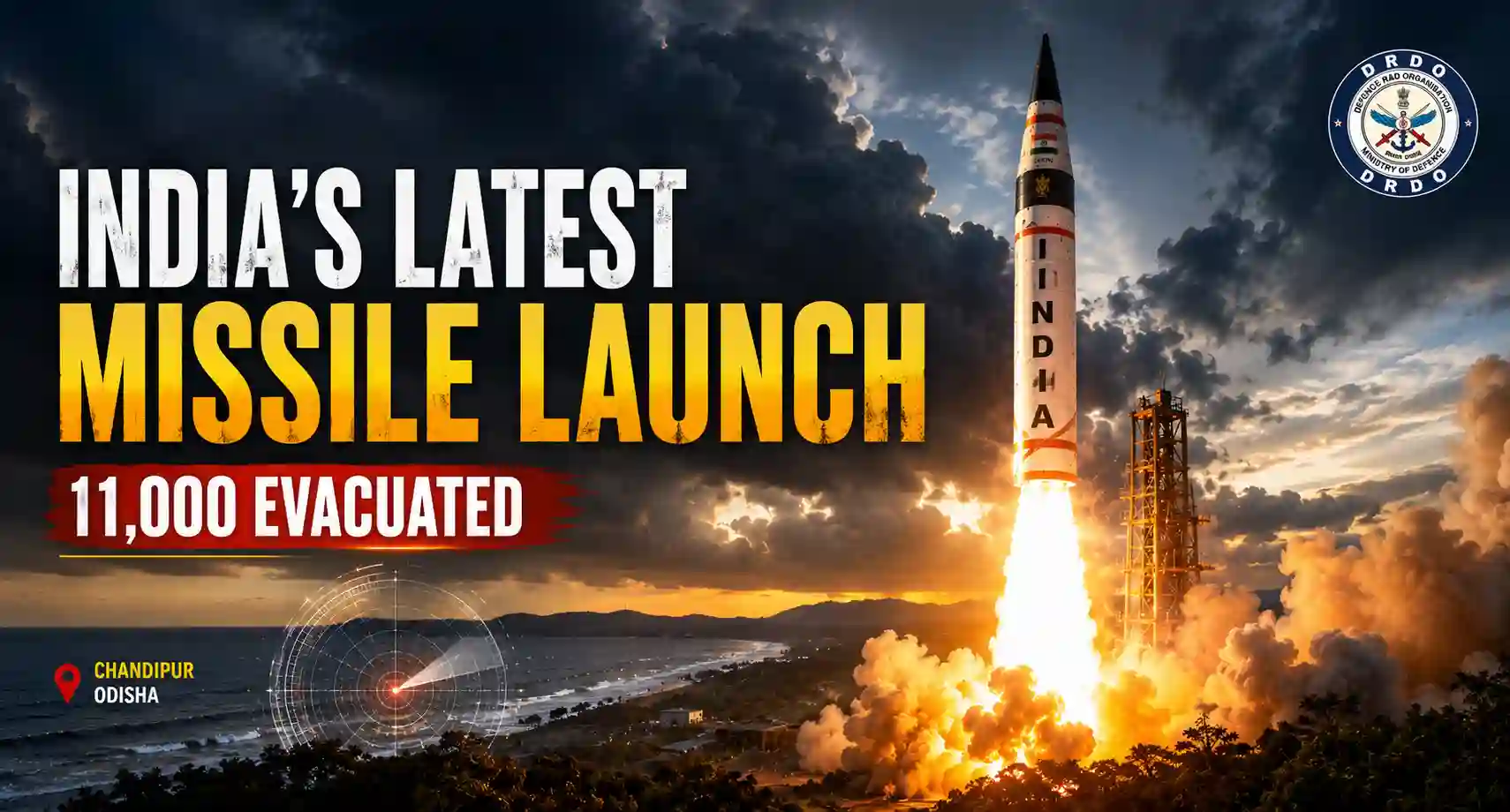
India’s latest missile launch has triggered intense global curiosity after more than 11,000 residents were evacuated from villages near the Integrated Test Range (ITR) at Chandipur in Odisha ahead of a highly sensitive DRDO operation.
What was initially described as a routine defence exercise has quickly evolved into one of the most closely watched military developments of 2026. The scale of the evacuation, combined with restricted airspace alerts, heightened coastal surveillance, and unusual security activity, has fueled speculation that India may be preparing to test an advanced strategic weapons system.
As debate grows across defence and geopolitical circles, many observers are now asking:
What exactly is India testing?
And does the launch carry a message far beyond South Asia?
Why Were 11,000 People Evacuated Before the Launch?
According to local authorities, the evacuation was conducted as a precautionary safety measure before the launch window began.
Villages located inside the projected risk corridor were temporarily relocated while DRDO and multiple security agencies tightened monitoring across the Bay of Bengal coastline.
Although civilian relocation is standard during sensitive military trials, analysts point out that evacuating more than 11,000 residents is uncommon for ordinary short-range systems. That has fueled speculation that the launch could involve:
- an advanced long-range missile,
- a hypersonic weapons platform,
- MIRV-capable technology,
- or a next-generation strategic deterrence system.
The secrecy surrounding the operation has only intensified online searches related to:
- “Why did India evacuate 11000 people?”
- “What missile is India testing?”
- “DRDO latest missile launch”
- and “India long-range missile capability.”
For many observers, the scale of the evacuation suggests this was far more than a standard defence exercise.
Is India Preparing to Test Agni-VI or Divyastra Technology?
Although officials have not publicly identified the missile involved, defence speculation online has increasingly focused on two possibilities:
- An upgraded Agni-V or Agni-VI platform,
- Or technology linked to India’s MIRV-capable Divyastra program.
The recent Divyastra missile test demonstrated India’s growing progress in Multiple Independently Targetable Reentry Vehicle (MIRV) capability — a system that allows a single missile to deploy multiple warheads against different targets.
At the same time, speculation surrounding the future Agni-VI missile program has intensified discussions about India’s expanding strategic deterrence capability.
If the current launch is connected to advanced MIRV systems, hypersonic glide technology, or extended-range platforms, it could represent a major milestone in India’s military modernisation efforts.
However, DRDO has not officially confirmed the identity of the missile being tested, and much of the current discussion remains speculative.
Read More: Agni-1 Missile Test 2026: Why India Tested It Again
Why Odisha Has Become the Centre of India’s Strategic Missile Program?
Over the years, Odisha’s eastern coastline has become one of the most important regions in India’s strategic defence infrastructure.
The Chandipur range and nearby facilities around Abdul Kalam Island provide ideal conditions for advanced launch operations because they offer:
- large sea corridors,
- sophisticated radar tracking systems,
- controlled test environments,
- and safer missile flight paths over the Bay of Bengal.
Several major Indian defence systems — including strategic ballistic missiles, interceptor platforms, and anti-ship weapons — have previously been tested from this region.
That is why unusual activity near the Odisha coast immediately attracts international attention.
Why Is the World Watching India’s Latest Missile Launch Closely?
This missile development comes at a time of rising geopolitical instability across multiple regions.
Global tensions involving:
- the United States and Iran,
- China and Taiwan,
- Russia and NATO,
- and expanding Indo-Pacific military competition
have transformed missile capability into one of the most important indicators of strategic power.
Modern missile systems are no longer viewed only as battlefield weapons.
They also represent:
- deterrence capability,
- sovereign military power,
- geopolitical influence,
- and strategic reach.
That is one reason this Indian missile test is being watched carefully not only in Asia, but also by global defence and intelligence communities.
Is India’s Missile Test Also a Strategic Warning to Global Powers?
While much of the international focus remains on China and Pakistan, some geopolitical observers believe India’s latest missile activity may also carry a broader message for larger global powers — including the United States.
Over the last two decades, the United States has repeatedly demonstrated its ability to project military and economic power across different regions through:
- sanctions,
- military interventions,
- strategic pressure campaigns,
- and involvement in conflicts involving countries such as Iraq, Iran, Libya, and Venezuela.
These developments have reshaped how rising powers think about long-term national security and strategic independence.
For many nations, one lesson has become increasingly clear:
Countries without credible strategic deterrence can become vulnerable during periods of geopolitical instability.
Why India May Be Thinking Beyond Asia
India’s defence strategy today appears to be evolving far beyond traditional regional calculations.
While India and the United States continue to maintain strategic cooperation in several areas, many analysts believe the relationship has become increasingly pragmatic and interest-driven rather than fully aligned.
At the same time:
- India continues balancing ties with Russia, Iran, Gulf nations, Western powers, and the broader Global South.
- The United States has shown renewed engagement with Pakistan in certain strategic areas,
- And global power competition is becoming increasingly unpredictable.
This changing geopolitical environment is one reason India has accelerated investment in:
- long-range missile systems,
- indigenous defence manufacturing,
- space and cyber capability,
- naval expansion,
- and strategic deterrence programs.
For many observers, the operation represents more than a technical launch.
It reflects India’s growing determination to maintain strategic independence in an increasingly unstable world order.
A Strategic Signal Hidden Behind the Launch?
Some analysts believe the secrecy surrounding the operation, combined with the scale of the evacuation, suggests India may be demonstrating more than technical capability alone.
Advanced missile systems also function as geopolitical signals.
In modern global politics, long-range strike capability represents:
- strategic reach,
- sovereign deterrence,
- military self-reliance,
- and the ability to defend national interests independently.
That is why many observers believe the implications of the launch extend beyond South Asia.
The message is not necessarily about aggression.
It is about demonstrating capability.
And in today’s geopolitical environment, capability itself can become a powerful form of strategic communication.
India’s Expanding Military and Strategic Ambitions
India’s military modernisation has accelerated rapidly over the last decade.
The country has significantly expanded investment in:
- long-range defence systems,
- AI-driven warfare technology,
- indigenous weapons manufacturing,
- naval modernisation,
- cyber defence,
- and space capability.
Under the Atmanirbhar Bharat initiative, India is increasingly attempting to reduce long-term dependence on imported strategic systems while strengthening domestic defence capability.
Today, many defence analysts believe the country is steadily evolving into a far more influential global strategic actor.
Final Thoughts
Officially, the Odisha evacuation was described as a precautionary measure ahead of a missile launch.
But the scale of the operation tells a much larger story.
With over 11,000 civilians temporarily relocated, heightened military security across the Bay of Bengal, and growing global speculation surrounding India’s long-range missile capability, the operation has evolved far beyond a routine military exercise.
Whether the system involved an advanced hypersonic platform, a Divyastra configuration, or future Agni-VI technology, one thing is becoming increasingly clear:
India’s strategic ambitions are expanding rapidly — and the world is watching closely.