
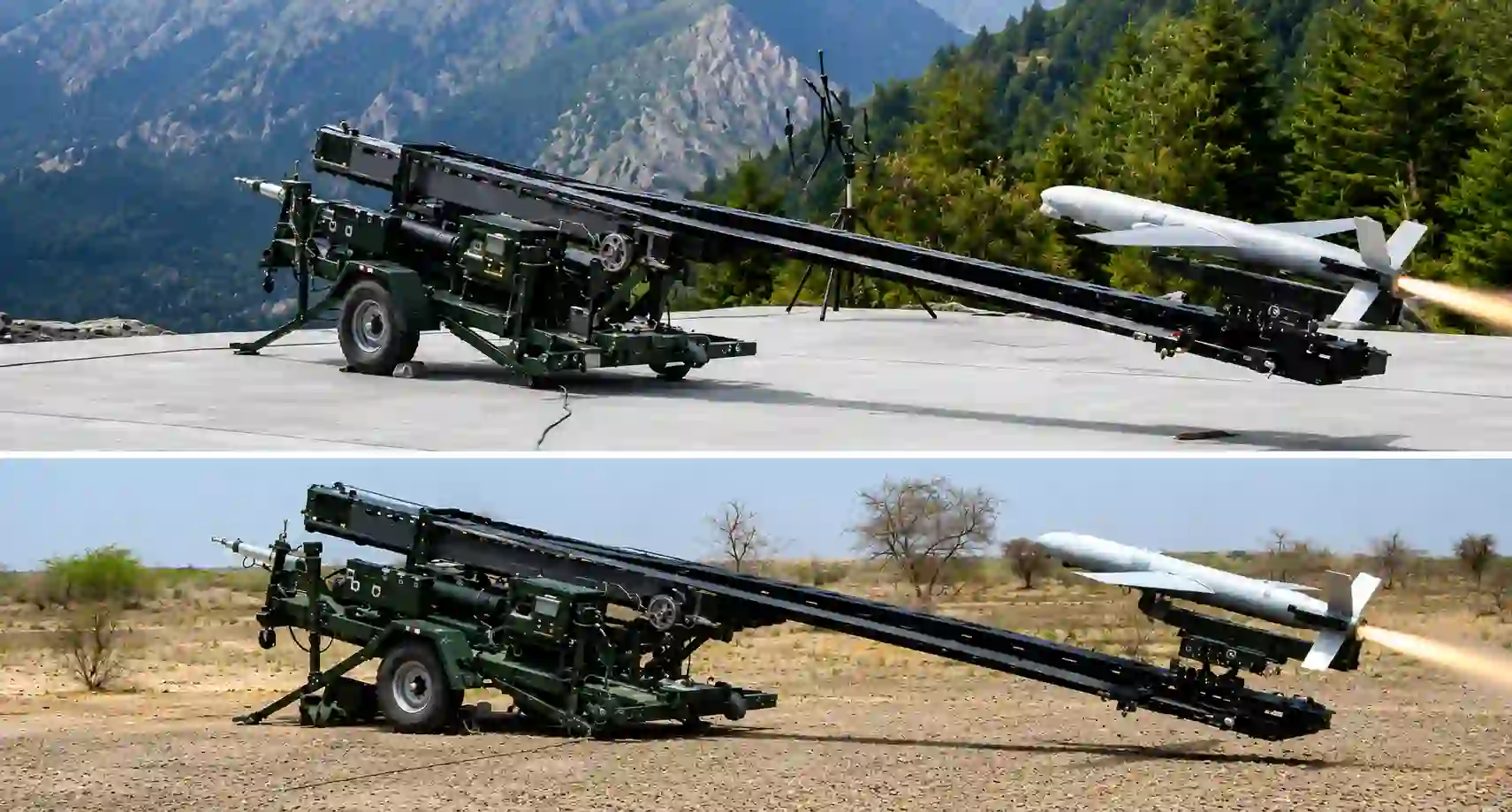
India is rapidly strengthening its indigenous drone warfare capabilities, and the Vayu Astra-1 Loitering Munition is now emerging as one of the country’s most important next-generation battlefield weapons.
Recently tested successfully in Rajasthan and Uttarakhand, this advanced kamikaze drone demonstrated long-range strike capability, precision targeting, and high-altitude operational performance.
As modern wars increasingly rely on autonomous systems and drone technology, the Vayu Astra-1 could significantly strengthen India’s armed forces. It could help address new threats along sensitive borders.
What Is Vayu Astra-1 Loitering Munition?
The Vayu Astra-1 Loitering Munition is an indigenous Indian autonomous strike drone designed to detect, track, and destroy enemy targets with high precision. Unlike conventional missiles that strike pre-fed coordinates, loitering munitions can remain airborne for extended periods while searching for targets before launching a final attack.
This capability makes them highly effective in fast-changing battlefield conditions where enemy assets may relocate frequently.
Key Features of Vayu Astra-1
- 100 KM strike range
- 90+ minutes flight endurance
- High-altitude operational capability
- Less than 1 metre strike accuracy
- 10 kg warhead payload
- Precision attack capability
- Indigenous Indian defence technology
The successful testing of the Vayu Astra-1 Loitering Munition highlights India’s growing ability to develop sophisticated battlefield drone systems domestically.
Why Vayu Astra-1 Is Important for India
Modern warfare is changing rapidly. Traditional military dominance based only on tanks, artillery, and fighter jets is now shifting toward drones, autonomous strike systems, and AI-enabled battlefield technologies.
Countries such as:
- China
- United States
- Israel
- Turkey
- Russia
have already integrated loitering munitions into frontline military operations.
India is now accelerating its own drone warfare ecosystem, and the Vayu Astra-1 could become a critical part of this transformation.
Why This Drone Matters
Reduced Risk to Soldiers
The drone can strike enemy positions without exposing Indian troops directly to hostile fire zones.
Deep Precision Strike Capability
Its 100-kilometre operational range allows forces to destroy targets deep inside enemy territory.
High-Altitude Warfare Readiness
The successful trials above 14,000 feet make the system highly relevant for the Himalayan border regions facing China.
Faster Tactical Response
Unlike traditional artillery systems, loitering munitions can quickly locate and engage moving enemy targets.
Successful Trials in Rajasthan and Uttarakhand
The Vayu Astra-1 Loitering Munition underwent major technical evaluations in two completely different terrains.
Pokhran Trials in Rajasthan
The Pokhran desert range allowed defence teams to test:
- strike precision,
- warhead effectiveness,
- target acquisition,
- long-range attack capability.
Reports suggest the drone successfully destroyed targets located nearly 100 kilometres away with exceptional accuracy.
High-Altitude Trials in Uttarakhand
The trials in the Joshimath-Malari sector were strategically significant because operating drones in mountainous terrain is extremely difficult.
Challenges include:
- thin air,
- freezing temperatures,
- harsh winds,
- navigation instability.
The successful performance in Uttarakhand proved that the Vayu Astra-1 can operate effectively in sensitive, high-altitude combat environments.
How Loitering Munitions Work
Loitering munitions combine the features of:
- surveillance drones,
- guided missiles,
- autonomous attack systems.
Step-by-Step Battlefield Operation
Launch Toward Target Zone
The system is launched toward a suspected enemy area.
Mid-Air Surveillance
Using onboard cameras and sensors, the drone scans the battlefield while remaining airborne.
Target Identification
Enemy assets such as:
- radar systems,
- bunkers,
- vehicles,
- troop formations,
- artillery positions
are identified either autonomously or by operators.
Precision Strike Attack
Once the target is confirmed, the drone dives directly into the enemy position and detonates its onboard warhead.
This kamikaze-style attack capability makes loitering munitions highly effective in modern warfare scenarios.
Major Capabilities of Vayu Astra-1
100 KM Operational Range
The long-range strike capability allows Indian forces to neutralise targets without exposing aircraft or soldiers to enemy air defence systems.
This provides important stand-off attack capability during conflict situations.
Precision Accuracy Under One Metre
The reported Circular Error Probable (CEP) of less than one metre highlights the system’s precision strike capability.
Such accuracy is critical in modern warfare, where avoiding collateral damage is increasingly important.
Powerful 10 KG Warhead
The drone carries a 10-kilogram warhead capable of destroying:
- enemy bunkers,
- command posts,
- radar systems,
- troop positions,
- lightly armoured vehicles.
Long Endurance Flight Time
The drone reportedly demonstrated more than 90 minutes of endurance during testing.
Longer endurance allows operators more time to search, identify, and confirm valuable targets before attack.
Importance of Vayu Astra-1 for the Indian Armed Forces
The Vayu Astra-1 Loitering Munition could support multiple branches of India’s military operations.
Indian Army Operations
The Army can use the system for:
- border surveillance,
- anti-infiltration missions,
- artillery suppression,
- tactical precision strikes,
- mountain warfare operations.
Indian Air Force Support
The Indian Air Force could deploy such drones for:
- suppression of enemy air defence,
- radar neutralisation,
- battlefield intelligence,
- precision tactical attacks.
Special Forces Missions
Loitering munitions are highly effective during covert operations because they provide silent surveillance and the capability for sudden precision attacks.
Why China and Pakistan Will Closely Monitor This Weapon
China has heavily expanded its military drone ecosystem with:
- swarm drones,
- AI-enabled UAVs,
- autonomous strike systems, and
- long-range reconnaissance platforms.
Pakistan has also increased cooperation with Turkey and China in drone warfare technology.
The induction of the Vayu Astra-1 could significantly enhance India’s deterrence capabilities in sensitive border sectors.
Its high-altitude capability is particularly important for operations near:
- Eastern Ladakh,
- Arunachal Pradesh,
- forward Himalayan sectors.
Future of Drone Warfare in India
India is now aggressively investing in:
- autonomous drones,
- swarm drone systems,
- anti-drone technology,
- AI-powered battlefield systems,
- precision-guided strike platforms.
The success of the Vayu Astra-1 Loitering Munition shows how Indian private defence companies are now capable of developing advanced indigenous warfare technologies.
This strengthens India’s defence manufacturing ecosystem while reducing dependence on foreign suppliers.
Other Indian Advanced Drone and Defence Systems
India is simultaneously developing multiple advanced battlefield technologies alongside loitering munitions.
Nagastra-1 Loitering Munition
The Nagastra-1 is another Indian kamikaze drone designed for tactical frontline operations. It provides portable precision strike capability for infantry units.
ALS-50 Loitering Munition
The ALS-50 is a vertical take-off and landing loitering munition designed specifically for difficult terrain and mountain warfare environments.
DRDO Anti-Drone System
India’s indigenous anti-drone system can detect, jam, and destroy hostile drones attempting to enter protected airspace around strategic military locations.
D4 Anti-Drone Technology
The DRDO-developed D4 system uses:
- radar tracking,
- electronic jamming,
- directed interception
to neutralise enemy UAV threats.
Here’s India’s Top 5 Long-Range Loitering Munitions
Read More: Suryastra Rocket Launcher and Its 300KM Strike Power
India’s Directed Energy Weapon Programmes
India is also investing heavily in directed energy weapons that could dominate future battlefields.
DRDO Laser Weapon Systems
India is developing laser-based weapons capable of destroying drones, missiles, and surveillance systems using concentrated energy beams.
DURGA II Directed Energy Project
The proposed DURGA II programme focuses on advanced high-energy laser weapons designed for next-generation battlefield defence applications.
Anti-Drone Laser Systems
India is also testing compact laser systems for rapid drone interception during border and strategic security operations.
These technologies could eventually work alongside systems like the Vayu Astra-1 to create a highly integrated autonomous warfare network.
Can Vayu Astra-1 Change Battlefield Warfare?
Defence experts increasingly believe loitering munitions are reshaping modern combat because they provide:
- low-cost precision attacks,
- autonomous strike capability,
- reduced troop exposure,
- rapid deployment flexibility,
- high battlefield survivability.
The Vayu Astra-1 Loitering Munition gives India an advanced combat solution suitable for:
- conventional warfare,
- mountain warfare,
- border conflicts,
- hybrid warfare environments.
Its combination of:
- precision,
- endurance,
- high-altitude capability,
- long-range attack performance
makes it one of the most strategically important indigenous drone systems currently under development in India.
Conclusion
The successful testing of the Vayu Astra-1 Loitering Munition is a major boost for India’s defence technology sector. With a 100 KM strike range, precision attack capability, and successful high-altitude trials, the drone shows India is preparing for the future of modern drone warfare.
As wars increasingly rely on drones and autonomous weapons, the Vayu Astra-1 could become an important battlefield asset for India. The indigenous kamikaze drone may help strengthen border security, surveillance, and rapid precision strike capability against future threats from China and Pakistan.