
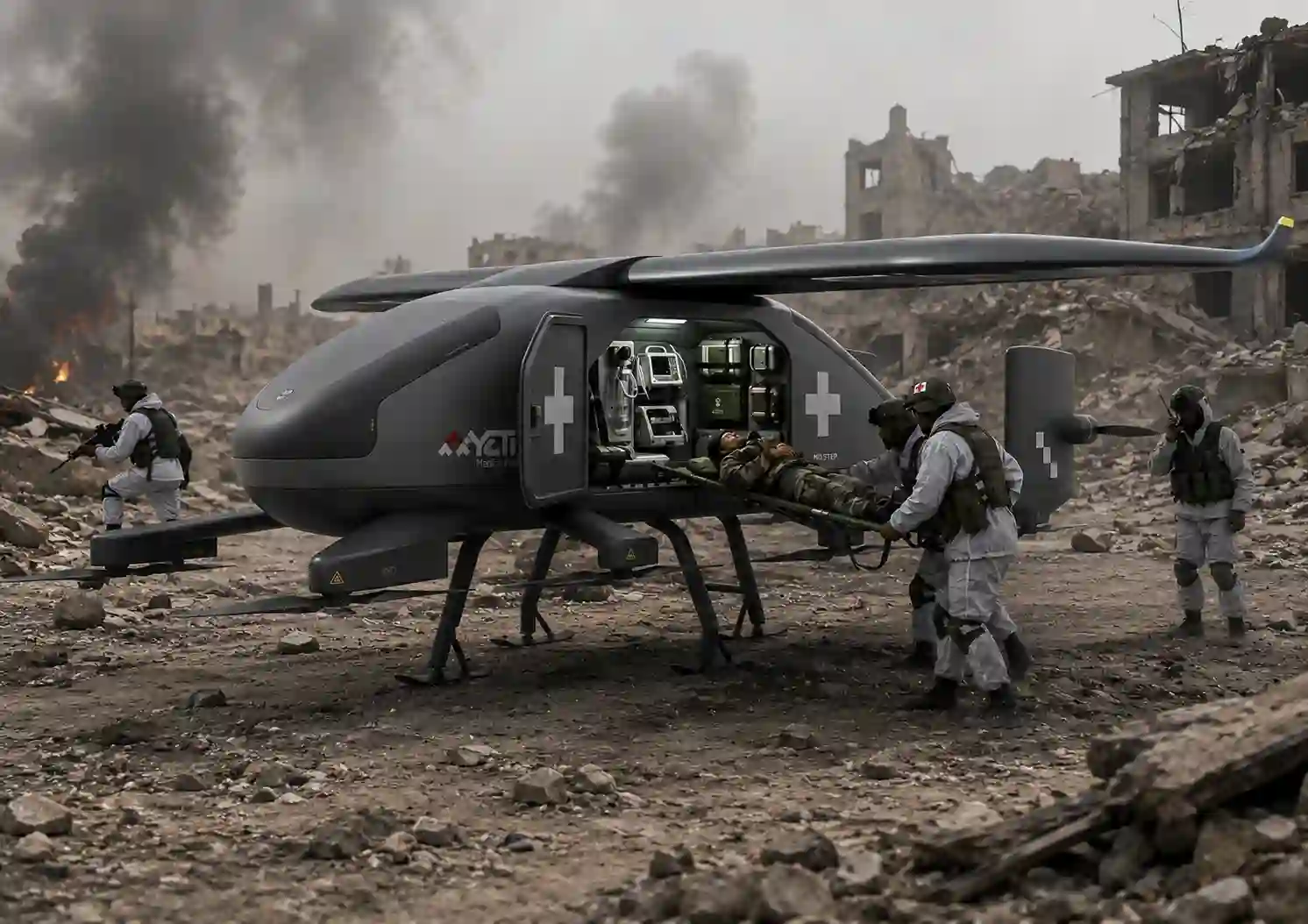
India’s new YETI UAV could change how future wars are fought in some of the world’s toughest battle zones. Developed by ideaForge, the heavy-lift military drone recently completed successful hover trials before advanced flight testing.
Unlike traditional supply convoys that can become easy targets during war, the YETI UAV is designed for autonomous battlefield logistics, casualty evacuation, and frontline resupply missions.
With no pilot at risk and the ability to operate in dangerous terrains, the platform represents a major leap in India’s indigenous military drone capability.
What Is the YETI UAV?
The YETI UAV is an all-terrain logistics unmanned aerial system designed for military and industrial delivery missions.
The platform is built for environments where conventional transport systems struggle to operate.
This includes:
- High-altitude sectors
- Border regions
- Desert operations
- Jungle terrain
- Offshore locations
- Disaster-hit zones
The drone is fully autonomous and supports day-and-night operations.
It is mainly designed for:
- Battlefield resupply
- CASEVAC operations
- Ammunition delivery
- Medical logistics
- Tactical transport
- Emergency response
The successful hover trial confirmed that the drone can safely lift, stabilise, and maintain controlled flight.
That is one of the first major milestones before advanced operational testing begins.
Read More: IdeaForge ZOLT UAV: Armed with Zeus Numerix in 2025 Trials
Key Specifications of the YETI UAV
The YETI UAV is designed as a heavy-lift tactical logistics platform.
Important Specifications
- Payload capacity: 50–200 kg
- Mission range: 50–200 km
- Max takeoff altitude: 6,500 m AMSL
- Operational temperature: -45°C to +55°C
- Wind tolerance: Up to 30 knots
- Cruise speed: Over 110 km/h
- VTOL system with 8 motors
- Fully autonomous BVLOS capability
- GNSS-denied navigation support
The drone can also operate from a small 5×5 meter landing area.
This makes it highly useful for frontline deployment and remote military operations.
Why Hover Trials Matter
Hover trials are extremely important during drone development.
During this phase, engineers test whether the aircraft can remain stable while flying at low altitude.
This helps validate:
- Flight software
- Sensor systems
- Motor performance
- Payload balance
- Autonomous stabilization
If a drone cannot hover safely, advanced testing becomes risky.
The successful hover trials show that the YETI UAV is progressing toward operational readiness.
The Close-Rear Is Now a Contested Battlespace
Modern warfare has changed completely.
Earlier, supply lines were considered safer than frontline combat zones.
That is no longer true.
Today, roads, bridges, and logistics convoys are becoming major targets during conflicts.
Enemy drones, UAV-enabled ISR systems, artillery strikes, and long-range attacks can easily track slow-moving supply vehicles.
This creates serious risks for troop sustainment operations.
Aircraft support is also limited because of:
- Weather windows
- Pilot availability
- Threat exposure
- Difficult terrain
The YETI UAV is designed to solve this exact problem.
The platform can move supplies directly into difficult or dangerous locations without depending on roads or manned aircraft.
This creates a low-signature logistics backbone for future military operations.
How the YETI UAV Can Help the Indian Armed Forces
Indian forces operate in some of the harshest terrains in the world.
This includes regions like:
- Siachen
- Ladakh
- Kargil
- Tawang
- Rajasthan deserts
- Andaman & Nicobar sectors
These areas often face supply challenges because roads become blocked or operational movement becomes risky.
The YETI UAV could play a major role in solving these logistics gaps.
Combat-Ready Mission Modes
The platform is designed with multiple battlefield configurations.
CASEVAC Mode
Payload: 100–200 kg
Range: Around 50–100 km
This mode is designed for casualty evacuation support.
The drone can carry injured soldiers and medical supplies from dangerous combat zones to safer treatment locations.
One of the biggest advantages is golden-hour evacuation capability without exposing pilots or medics to enemy threats.
The platform can also operate in contested airspace and denied zones where helicopters face risks from MANPADS threats, UAV ISR tracking, and enemy fire.
Tactical Transport Mode
Payload: 200 kg
Range: Around 50 km
This mode focuses on heavy battlefield resupply.
The drone can transport:
- Ammunition
- Engineering equipment
- Construction materials
- Power modules
- Tactical supplies
This reduces dependence on slow-moving military convoys.
Delivery Mode
Payload: 50–200 kg
Range: 50–200 km
This mode supports autonomous last-mile delivery missions.
The drone can move:
- Water
- Fuel
- Rations
- Spare parts
- Mission-critical stores
directly to frontline locations.
Advanced Features of the YETI UAV
The YETI UAV includes several advanced technologies designed for modern battlefield conditions.
GNSS-Denied Navigation
The drone can continue operations even when GPS signals are jammed or unavailable.
This is extremely important during electronic warfare situations.
Precision Autonomous Landing
The platform can accurately land in small and difficult locations.
This includes:
- Small clearings
- Remote posts
- Helipads
- Mountain sectors
Secure Communications
The drone supports encrypted communication systems for secure battlefield operations.
Rapid Deployment
The platform can move from storage to operational readiness within minutes.
Small teams can deploy the drone quickly without requiring large infrastructure.
Why This Drone Matters for India
The YETI UAV is more than just another drone project.
It reflects India’s growing push toward self-reliant defence manufacturing and advanced military technology.
The platform is specifically designed around Indian military logistics challenges.
This includes:
- High-altitude sustainment
- Border logistics
- Desert resupply
- Island operations
- Disaster response missions
The drone also supports India’s Make in India defence initiative.
Most importantly, it shows how unmanned systems are becoming critical for future warfare.
Explore: ideaForge SWITCH UAV: 120-Minute Flight Time, 15 km Range
Conclusion
The successful hover trials of the YETI UAV mark an important milestone for India’s defence drone ecosystem.
The platform is designed not only for cargo transport but also for modern battlefield logistics, emergency response, and casualty evacuation missions.
From Siachen supply operations to contested border logistics, the drone has the potential to transform how Indian armed forces manage frontline sustainment and operational mobility.
As warfare increasingly shifts toward autonomous systems and low-signature operations, the YETI UAV could become one of India’s most important indigenous tactical logistics platforms for the future battlefield.