
A single swarm of cheap drones can destroy military assets worth billions within minutes. Modern warfare is changing rapidly, and countries across the world are racing to build new defence systems capable of stopping these threats before they reach their targets.
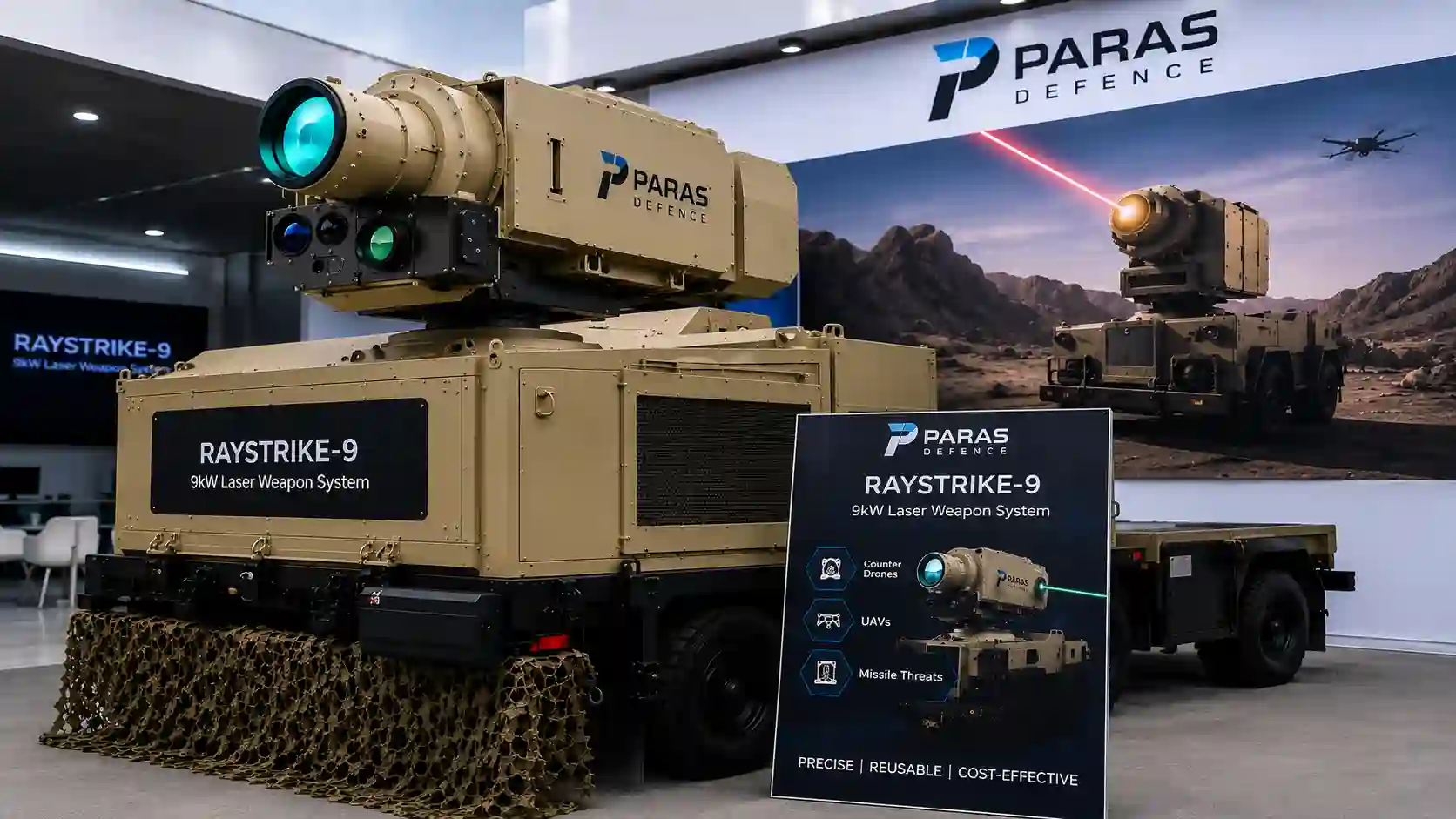
India is now entering this futuristic battlefield with the RayStrike-9 Laser Weapon, an advanced Directed Energy Weapon designed to destroy drones, missiles, and aerial threats using high-powered laser beams.
Along with projects like Surya, Sahastra Shakti, and DURGA-II, India is quietly building a new generation of indigenous laser-based defence systems that could completely transform the country’s future air defence strategy.
What Is The RayStrike-9 Laser Weapon?
The RayStrike-9 Laser Weapon is an advanced Indian Directed Energy Weapon (DEW) being developed to counter modern aerial threats such as:
- Drone swarms
- Loitering munitions
- Surveillance UAVs
- Low-flying missile threats
- AI-enabled autonomous drones
Unlike traditional missiles, the RayStrike-9 Directed Energy Weapon uses concentrated laser energy instead of explosive ammunition.
The system is linked with India’s growing investment in:
- Anti-drone warfare
- Advanced battlefield technologies
- AI-enabled defence systems
- Indigenous military modernisation
The project also supports India’s long-term Atmanirbhar Bharat defence manufacturing mission.
Read More: Inside India’s New Low-Cost Anti-Drone Missiles
Explore: Indrajaal Ranger: Anti-Drone Patrol Vehicle
Why India Suddenly Needs Laser Weapons
The nature of warfare has changed dramatically in recent years.
Small drones costing only a few thousand dollars are now capable of:
- Destroying tanks
- Damaging air defence systems
- Tracking troop movements
- Attacking military airbases
- Overwhelmingly expensive missile systems
Recent conflicts in:
- Ukraine
- Israel-Gaza
- The Red Sea region
- Armenia-Azerbaijan
have shown how dangerous drone warfare has become.
Traditional interceptor missiles are effective, but they are very costly. Using multi-million-dollar missiles to target low-cost drones is unsustainable during large-scale attacks.
This is exactly why countries are rapidly investing in Directed Energy Weapons like the RayStrike-9 Laser Weapon.
Know More: VyomKavach CUAS: India’s Advanced Anti-Drone Defence
How The RayStrike-9 Directed Energy Weapon Works
The RayStrike-9 Directed Energy Weapon works very differently from conventional weapons.
Instead of launching missiles, the system fires a focused beam of laser energy directly at the target.
Step-By-Step Working Process
1. Threat Detection
Advanced radar and electro-optical sensors detect incoming drones and other aerial threats.
2. Precision Tracking
The system locks onto the target using AI-assisted tracking technologies.
3. Laser Engagement
A high-energy laser beam is directed toward the enemy object.
4. Thermal Destruction
The laser rapidly heats critical components of the target, causing the system to fail.
5. Neutralisation
The drone or missile crashes, burns, or becomes inoperable.
The entire process can happen within seconds.
Why The RayStrike-9 Laser Weapon Is So Important
The biggest advantage of laser weapons is speed.
Laser beams travel at the speed of light, making interception almost instantaneous.
Major Advantages Of RayStrike-9
Extremely Fast Response Time
The system can engage threats immediately after detection.
Low Cost Per Engagement
Unlike missiles, laser weapons do not require expensive ammunition reloads after every shot.
Powerful Anti-Drone Capability
The system is especially important against drone swarm attacks.
High Precision Accuracy
Laser weapons can target threats with minimal collateral damage.
Silent And Hard-To-Detect Operation
Unlike missiles, laser attacks are challenging to visually detect during engagement.
These advantages make the RayStrike-9 Directed Energy Weapon highly valuable for future battlefield operations.
Why Drone Swarms Are Becoming A Nightmare For Militaries
Drone swarm warfare is one of the biggest military challenges of the modern era.
Instead of sending one large aircraft, enemies can launch hundreds of small drones simultaneously.
Imagine hundreds of autonomous drones approaching an Indian airbase at night. Traditional systems may eventually run low on interceptor missiles during prolonged attacks. A laser-based air defence system can continue engaging threats as long as sufficient power is available.
This creates major problems because:
- Traditional air defence systems can become overloaded
- Missile interception costs become extremely high
- Detection becomes more difficult
- Multiple targets attack at the same time
China is heavily investing in:
- AI-powered swarm drones
- Autonomous battlefield systems
- Electronic warfare technologies
Pakistan has also increased the use of:
- Border surveillance drones
- Tactical UAV systems
- Cross-border drone operations
India’s future wars may involve large-scale drone attacks. The RayStrike-9 Laser Weapon is being viewed as a possible solution to this growing threat.
Importance Of RayStrike-9 For The Indian Air Force
The Indian Air Force operates strategic military assets that require constant protection.
Enemy drones can target:
- Airbases
- Radar stations
- Missile sites
- Fuel depots
- Command centres
Traditional systems alone may not be enough against mass drone attacks.
How RayStrike-9 Helps The Indian Air Force
Protection Of Strategic Airbases
Laser systems can provide rapid close-range defence.
Layered Air Defence
The weapon can work alongside:
- S-400
- Akash Missile System
- Anti-drone radars
- Electronic warfare systems
Faster Battlefield Reaction
Laser interception happens almost instantly.
Reduced Operational Costs
Continuous missile launches are expensive during prolonged conflicts.
The RayStrike-9 Directed Energy Weapon could eventually become a critical part of India’s multi-layered air defence shield.
RayStrike-9 Laser Weapon Vs Traditional Missile Defence
| Feature | RayStrike-9 Laser Weapon | Traditional Missile System |
|---|---|---|
| Engagement Speed | Near instant | Slower |
| Cost Per Shot | Very low | Very high |
| Ammunition Requirement | No physical ammo | Requires missiles |
| Best Against | Drone swarms, UAVs | Aircraft, missiles |
| Reload Time | Minimal | Required |
| Visibility | Hard to detect | Clearly visible |
This comparison clearly shows why military laser technology is becoming strategically important worldwide.
But the RayStrike-9 Laser Weapon may only be the beginning. India’s next-generation directed energy systems could become even more powerful in the coming years.
India’s Growing Directed Energy Weapon Ecosystem
India is not developing only one laser weapon. Multiple advanced projects are now being explored to strengthen the country’s future combat systems.
Sahastra Shakti Laser Weapon
The Sahastra Shakti system is believed to be designed for short-range anti-drone operations.
Key Features
- Mobile battlefield deployment
- Truck-mounted laser system
- Designed for UAV interception
- Rapid-response air defence role
The project highlights India’s increasing focus on tactical laser warfare technologies.
Surya Directed Energy Weapon
The Surya Laser Weapon is considered one of India’s most ambitious future directed energy projects.
Expected Capabilities
- High-power laser output
- Long-range engagement
- Possible anti-missile interception
- Strategic air defence support
If successfully developed, Surya could place India among global leaders in advanced military laser technology.
DURGA-II Laser Weapon
The DURGA-II project is another futuristic Indian Directed Energy Weapon initiative.
Planned Role
- Air defence support
- Multi-platform deployment
- Sea, land, and air integration
- High-energy laser interception
This project reflects India’s long-term military modernisation plans.
Can Laser Weapons Replace Missiles Completely?
Not yet.
Despite their advantages, laser weapons still face several technical limitations.
Current Challenges
High Energy Requirement
Laser systems need enormous power generation capability.
Weather Limitations
Rain, fog, dust, and smoke can reduce effectiveness.
Thermal Management
Managing heat during continuous firing remains difficult.
Long-Range Challenges
Laser effectiveness decreases over longer distances.
Because of these issues, experts believe laser weapons will initially support missile systems rather than replace them entirely.
How RayStrike-9 Supports India’s Defence Self-Reliance Mission
India has long depended on imported military technologies.
Projects like the RayStrike-9 Laser Weapon help strengthen:
- Indigenous defence research
- Domestic manufacturing
- Indian military innovation
- Future defence exports
This is extremely important for India’s long-term strategic independence and future defence growth.
The Future Of Warfare Has Already Started
Future battlefields may look completely different from traditional wars.
Instead of large troop movements alone, wars may increasingly involve:
- AI-controlled drones
- Autonomous weapons
- Cyber attacks
- Electronic warfare
- Laser-based air defence systems
Countries that master these technologies early could dominate future conflicts.
The RayStrike-9 Directed Energy Weapon indicates that India is seriously preparing for the next generation of warfare.
Conclusion
The RayStrike-9 Laser Weapon is far more than another defence project. It represents India’s growing ambition to become a major power in next-generation warfare technologies.
As drone swarm attacks, AI-enabled combat systems, and autonomous aerial threats continue to evolve, laser-based defence systems may soon become essential for protecting military bases, strategic infrastructure, and national airspace.
Along with projects like Surya, Sahastra Shakti, and DURGA-II, the RayStrike-9 Directed Energy Weapon highlights how India is rapidly building a smarter, faster, and more self-reliant defence ecosystem for the future.
In the coming decade, wars may not be won only with bullets and missiles, but with invisible beams of energy moving at the speed of light — and India wants to be ready before that future fully arrives.