
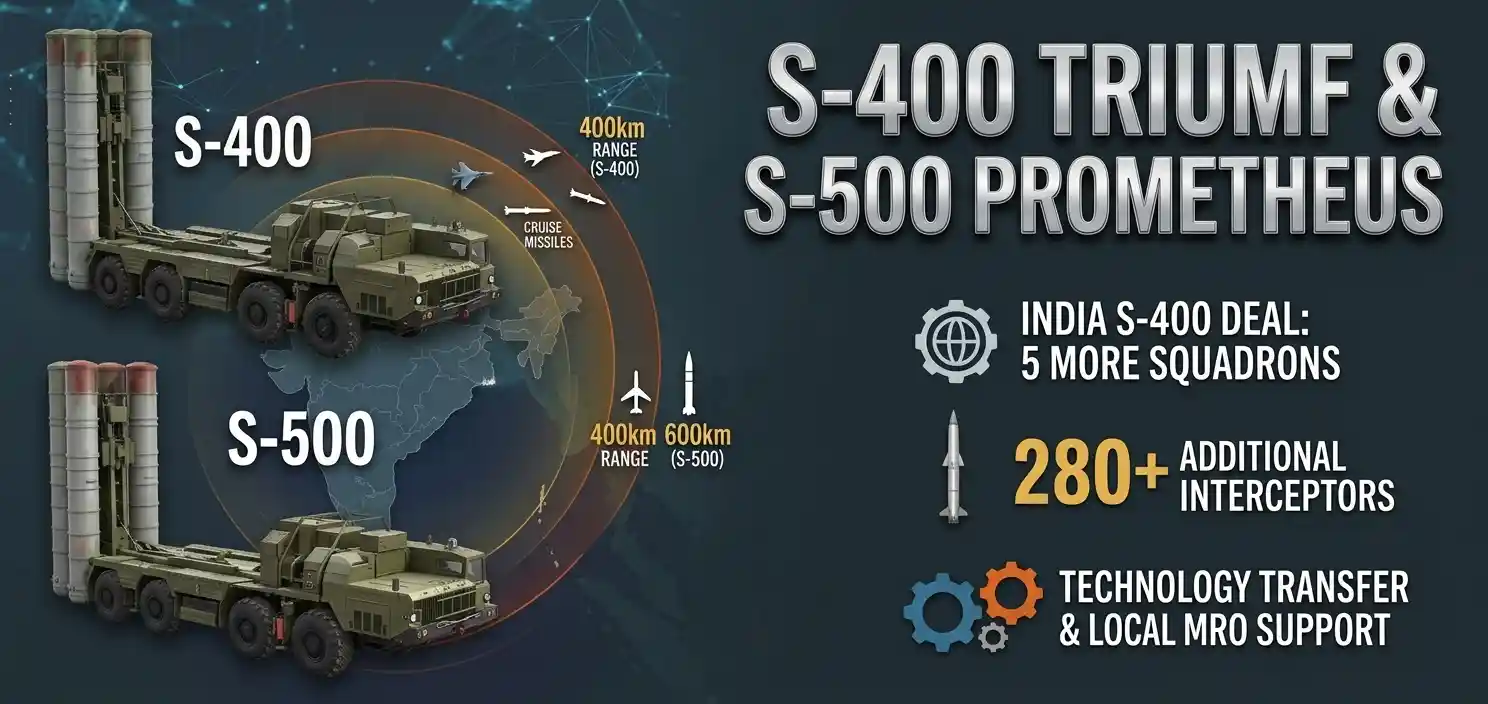
India is strengthening its air and missile defence network with the S-400 Triumf and newer S-500 Prometheus. Russia is also pitching the S-500 alongside the Su-57, linking the proposal to wider India-Russia defence cooperation. This comes as the proposed India S-400 deal for five additional squadrons could further strengthen the country’s long-range air-defence network.
The two systems are not the same. The S-400 is mainly a long-range air-defence system, while the S-500 is designed for more demanding air and missile-defence missions, especially against ballistic missiles and high-altitude threats.
With a potential India S-500 deal also drawing attention, India must weigh the benefits of another advanced Russian system against its own Project Kusha and indigenous Ballistic Missile Defence (BMD) programme.
Why India Needs More S-400
India originally acquired the S-400 because it had a major gap in long-range air defence. Earlier systems such as Akash, Akash-NG and MR-SAM could protect important areas, but they did not offer the same reach.
The S-400 can engage fighter aircraft, bombers, AWACS aircraft, aerial refuelling tankers and cruise missiles. Its different interceptors allow operators to select missiles according to the target and engagement range.
The 40N6 is associated with a claimed range of up to 400 kilometres. The system also uses the 48N6E3 and shorter-range 9M96 family.
The S-400 gives India a powerful long-range protective layer, but its ballistic-missile role is more limited than a dedicated BMD architecture.
S-400 Air Defence System: India’s Sudarshan Chakra Explained
India’s Layered Air-Defence Network
The S-400 is only one part of India’s wider network.
| System | Approx. range | Main role |
|---|---|---|
| Akash | 25–45 km | Short/medium-range air defence |
| Akash-NG | 70–80 km | Medium-range air defence |
| MR-SAM | 70–100 km | Medium-range air defence |
| S-400 | Up to 400 km | Long-range air defence |
| Project Kusha | 150–350 km planned | Indigenous long-range air defence |
This creates a clear reason for additional S-400 squadrons. India still needs a mature long-range system while Project Kusha moves through development, testing and production.
India S-400 Deal: Why Five More Squadrons Matter
India is pursuing five additional S-400 squadrons. The proposed deal is worth more than ₹50,000 crore, far above the ₹500 crore figure mentioned in some early discussions.
The proposal was cleared by the Defence Acquisition Council (DAC), and Russia has submitted its response. Deliveries could begin roughly three years after signing.
The additional purchase could eventually take India’s planned S-400 fleet to 10 squadrons.
India is also seeking more than 280 additional S-400 interceptor missiles to replenish stocks and maintain operational readiness.
The new proposal is significant for another reason. Reports indicate possible MRO support in India, technology transfer and local participation, including possible joint production of some units. That would be a major change from the original off-the-shelf acquisition.
Project Kusha: India’s Indigenous Alternative
India does not want permanent dependence on imported long-range air defence. Project Kusha is being developed as an indigenous answer.
Its planned interceptor classes are:
- M1: around 150 km
- M2: around 250 km
- M3: around 350 km
The system is intended to engage aircraft, cruise missiles, drones and other high-value aerial targets. The common missile design could help simplify development and testing, although large-scale production will still take time.
This creates a transition period. The S-400 can provide proven long-range protection while Kusha moves toward maturity and mass production.
Project Kusha: India’s Air Defence System
S-500 Is Not Simply a Bigger S-400
The biggest mistake in an S-400 vs S-500 comparison is treating them as identical systems with different ranges.
The S-400 is primarily built around long-range air defence. The S-500 places greater emphasis on advanced air and missile defence, including ballistic missiles and high-altitude targets.
Its reported 77N6 interceptor family is associated with the missile-defence role. Russian claims and open-source estimates suggest the system could engage certain ballistic-missile targets at around 500–600 kilometres.
Another interceptor is associated with aircraft and cruise-missile defence, with a reported range around 400 km.
The S-500 is also claimed to have a reaction time of about 3–4 seconds, compared with roughly 9–10 seconds for the S-400. These figures should be treated as claimed specifications rather than independently verified performance.
India S-500 Deal: Why the System Could Matter
The S-500 is newer than the S-400. The first S-500 system was reported to enter operational service in December 2025.
India would need to consider reliability, production, maintenance, cost, support and combat experience before buying it.
Russia’s pitch is strategically important because India and Russia have a long defence relationship.
India Already Has Ballistic Missile Defence
India’s S-500 decision is complicated by its own Ballistic Missile Defence programme.
Phase One includes Prithvi Air Defence (PAD) and Advanced Air Defence (AAD) interceptors, designed to provide different interception layers.
India therefore already has an indigenous BMD foundation. This makes the S-500 different from the S-400, which filled a clearer long-range air-defence gap.
Project Kusha also adds another indigenous option. Former DRDO leadership has compared Kusha more closely with the S-500 in technological scope and operational intent than with the S-400.
Operation Sindoor and the Missile Threat
Operation Sindoor highlighted why India needs a layered defence network.uda
The source material notes Pakistan’s use of Fatah-2 systems and India’s classification of Fatah-2 as a ballistic-missile system. It also describes a reported interception of a missile moving toward the Delhi region around Sirsa.
A fighter, drone, cruise missile or ballistic missile can require different responses. Modern air warfare therefore needs multiple layers, sensors and interceptors.
Could India Buy Both S-400 and S-500?
Yes. There is no need to choose only one.
A future Indian network could combine:
- Akash and Akash-NG for shorter-range protection.
- MR-SAM for medium-range coverage.
- S-400 for long-range air defence.
- Project Kusha for indigenous long-range coverage.
- PAD and AAD for ballistic-missile defence.
- S-500, if acquired, for another high-end missile-defence layer.
These systems can complement rather than replace one another.
The S-400 is the more immediate requirement. The S-500 would add strategic depth, redundancy and another high-end missile-defence option.
Make in India and the Russia Defence Deal
India’s original S-400 acquisition was largely an off-the-shelf purchase. It did not provide the same level of domestic production opportunities now being discussed for future deals, and India remains dependent on foreign supply for the system’s interceptors.
This matters.
India increasingly wants defence imports to support Make in India, local maintenance, technology development and domestic manufacturing.
Foreign procurement can make sense when India needs capability quickly, while defence diplomacy, timing and strategic relationships also influence decisions.
Final Takeaway
The answer to “Will India buy S-500 from Russia?” is still a strategic question, while the need for additional S-400 capability is easier to understand.
The S-400 fills an immediate long-range air-defence requirement. Buying five more squadrons can strengthen coverage while Project Kusha matures.
The S-500 is different. India already has indigenous ballistic-missile defence and is developing Kusha, so the Russian system would add another advanced layer rather than fill a completely empty gap.
For India, the strongest path may be a layered network combining S-400, Project Kusha, BMD systems, Akash-family missiles and potentially S-500.
The decision will ultimately depend on operational needs, cost, technology transfer, local production, indigenous development and India’s long-term defence partnership with Russia.