
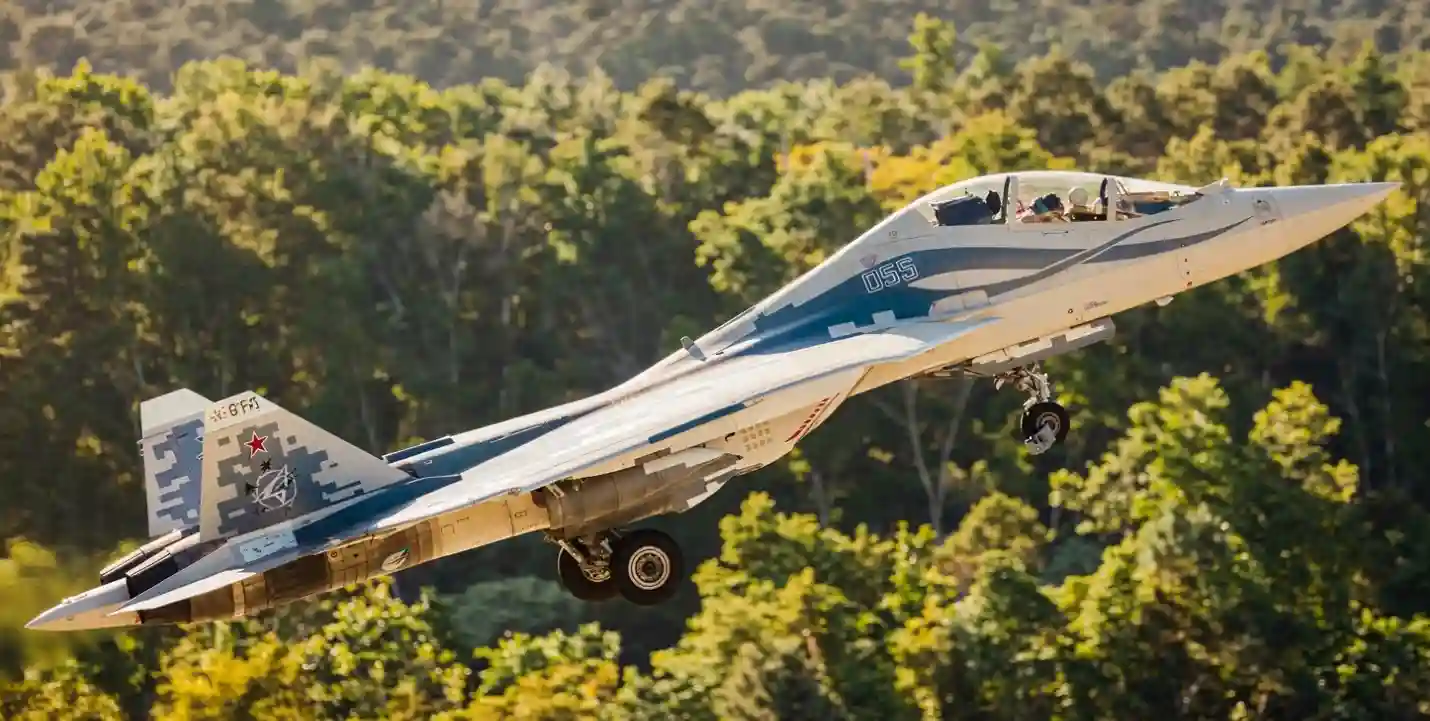
Russia’s latest Twin-seater Su-57 is rapidly becoming one of the most talked-about defence developments in Asia. What makes this stealth jet important is not just its combat capability, but the growing belief that many of its features were redesigned around Indian Air Force requirements after India exited the FGFA program in 2018.
The aircraft now promises advanced drone control, better mission coordination, stronger engines, and possible technology transfer. At a time when China is rapidly expanding stealth fighter production, and Pakistan is moving closer to fifth-generation combat capability, this Russian move could become a major turning point for India’s future air warfare plans.
Why Russia’s New Variant Is Drawing Attention
This is not being presented as a routine fighter upgrade. Russian analysts are describing the aircraft as a future battlefield management platform capable of handling both manned and unmanned warfare simultaneously.
Unlike traditional stealth fighters, the new configuration is expected to:
- Coordinate combat drones during missions
- Manage air battles in real time
- Conduct electronic warfare operations
- Handle deep strike missions
- Function as a compact airborne command centre
That changes the role of a modern fighter completely.
The second crew member is no longer simply a co-pilot. Instead, that officer could manage sensors, drone operations, electronic warfare systems, and battlefield coordination while the pilot focuses entirely on flying and combat manoeuvres.
This is one of the biggest reasons the aircraft is now attracting serious global attention.
Explore: Su-57E Deal India: 40 Flyaway + 90 HAL Jets Near Putin Visit
Why India Left the FGFA Program
India and Russia were earlier working together on the FGFA project based on the Su-57 stealth fighter. However, India officially stepped away from the program in 2018 after several disagreements over performance, technology access, and operational requirements.
Stealth Performance Concerns
Indian officials reportedly believed the aircraft’s stealth capability was still below the level expected from a mature fifth-generation fighter.
Engine-Related Issues
Earlier production models relied on interim engines, raising concerns regarding:
- Reliability
- Supercruise capability
- Maintenance costs
- Long-term operational readiness
Technology Transfer Disagreements
India also wanted greater access to:
- Aircraft source codes
- Indigenous weapons integration
- Indian avionics systems
- Local production capability
Know More: Su-57 Production in the Nashik Facility | HAL & Russia Deal
India’s Interest in a Dual-Seat Configuration
One of the most important but less discussed issues was the Indian Air Force’s preference for some twin-seat aircraft alongside single-seat variants.
The IAF has traditionally valued dual-seat fighters for:
- Long-range strike operations
- Battlefield management
- Pilot training
- Complex weapons coordination
- Future drone warfare missions
At that time, Russia remained focused mainly on the single-seat configuration. Years later, the newly revealed version now appears much closer to India’s earlier operational demands.
Why The Indian Air Force Could Be Interested Again In The Twin-seater Su-57
The security situation around India has changed significantly over the past few years.
China is steadily increasing production of advanced stealth fighters like the J-20, while Pakistan is expected to strengthen its future air combat capability with Chinese support.
At the same time, India’s indigenous AMCA stealth fighter project is still under development and may take several more years before operational induction.
Because of this, defence analysts increasingly view Russia’s new variant as:
- A temporary fifth-generation solution
- A strategic force multiplier
- A drone-command combat jet
- A bridge before AMCA enters service
Russia is also reportedly offering stronger technology cooperation this time, making future negotiations far more attractive than before.
What Makes This Aircraft Different
The most visible change is the enlarged cockpit section designed for two crew members.
However, the real transformation is happening inside the aircraft.
Drone Swarm Control Capability
The stealth jet is expected to coordinate multiple combat drones simultaneously, especially the Russian S-70 Okhotnik stealth drone.
Possible drone missions include:
- Reconnaissance operations
- Deep penetration strikes
- Electronic warfare attacks
- Target designation
- High-risk combat missions
This is one of the clearest signs that Russia is preparing for future manned-unmanned warfare concepts.
Mini-AWACS Role
Russian analysts have even described the aircraft as a “mini-AWACS” because it may function as a compact airborne command-and-control platform during combat operations.
Instead of operating alone, the fighter could manage a wider combat network involving drones, sensors, and other aircraft in real time.
Improved Mission Efficiency
The second crew member could also reduce pilot workload during long-duration operations.
Modern air combat increasingly depends on managing enormous amounts of real-time battlefield data, electronic warfare systems, and sensor information. Dividing these responsibilities between two crew members could significantly improve mission effectiveness.
Will The Twin-Seat Design Reduce Stealth?
This remains one of the biggest debates surrounding the aircraft.
Many defence observers believe adding a second seat could slightly reduce stealth performance because a larger canopy and cockpit area may increase radar reflections.
Why Some Experts Are Concerned
A dual-seat stealth aircraft usually requires:
- A larger canopy
- Additional onboard systems
- Bigger fuselage sections
- More complex airframe shaping
All of these factors can potentially increase radar cross-section.
However, Russian designers reportedly believe modern stealth shaping techniques and radar-absorbing materials can minimise most of these penalties.
More importantly, Russia appears willing to accept a small stealth compromise because the operational advantages of a second crew member may outweigh the drawbacks.
Advantages Of The Second Crew Member
- Better drone coordination
- Faster battlefield decisions
- Improved electronic warfare management
- Reduced pilot fatigue
- Higher efficiency during long-range missions
Modern warfare is becoming increasingly network-centric, and battlefield coordination is now considered almost as important as stealth itself.
Russia’s New Engine Could Solve Earlier Problems
One of the most important updates involves the aircraft’s next-generation engine.
Earlier Su-57 variants mainly used interim AL-41 engines, but Russia is now preparing the advanced Izdeliye 177S, also known as the AL-51F1 engine, for future production aircraft.
The future success of this program depends heavily on the maturity of this new power plant.
Read More: Technical Details of the 177S Engine Revealed for India
Expected Advantages Of The New Engine
Higher Thrust
The engine is expected to deliver stronger combat performance and better acceleration.
Better Fuel Efficiency
Improved fuel efficiency could increase operational range and mission endurance.
Improved Supercruise
The aircraft may sustain supersonic speeds without afterburners more effectively.
Reduced Infrared Signature
Lower infrared visibility may improve survivability against modern air defence systems.
Advanced 3D Thrust Vectoring
The engine is also expected to provide exceptional manoeuvrability during close combat engagements.
Russian defence sources claim the engine is finally approaching large-scale production readiness after years of delays. This matters because engine maturity was one of India’s biggest concerns during the original FGFA discussions.
Could India Eventually Operate Both Versions?
Some defence analysts believe India could eventually consider operating both single-seat and twin-seat variants together.
Possible Future Structure
Single-Seat Variant
Likely suited for:
- Air superiority missions
- Stealth penetration strikes
- High-speed combat operations
Dual-Seat Variant
Potentially suited for:
- Drone warfare coordination
- Battlefield command roles
- Electronic warfare operations
- Long-range strike management
Such a combination could help the Indian Air Force prepare for future sixth-generation warfare concepts while strengthening current operational capability.
Final Conclusion
The new Twin-seater Su-57 appears to be a direct attempt to address many of the concerns India raised before leaving the FGFA program. From advanced drone warfare capability and improved mission coordination to stronger engines and possible technology transfer, the aircraft reflects a major shift in Russian thinking.
With stealth threats growing across the region and modern air combat evolving rapidly, the Twin-seater Su-57 could eventually become an important option for the Indian Air Force alongside India’s long-term AMCA program.
If Russia successfully delivers the new engines and improves production capability, the Twin-seater Su-57 may emerge as one of the most important combat aviation decisions India faces before the arrival of its indigenous fifth-generation fighter.