
Indian Nuclear Submarine News: Why Experts Are Suddenly Discussing India’s Underwater Nuclear Security
India’s most secretive nuclear defence program is suddenly under intense scrutiny after satellite imagery reportedly revealed all four Arihant-class nuclear submarines together at a naval base in Visakhapatnam. For most Indians, this may look like another defence update.
But for military experts, this is a serious strategic concern. A nuclear submarine is supposed to remain hidden, invisible, and unpredictable during conflict. That is why the latest satellite observations have triggered difficult questions about India’s underwater nuclear deterrence, operational secrecy, and long-term preparedness.
The development is now drawing attention among people searching for:
- Indian nuclear submarine news
- India’s 4th nuclear submarine spotted
- INS Aridhaman latest update
- India’s submarine security
- Arihant-class submarine
- India’s nuclear deterrence
- India submarine leak
- Can China track Indian submarines
And the concern is simple:
If all nuclear submarines are docked together, then who is guarding India underwater?
The Satellite Images That Triggered Concern
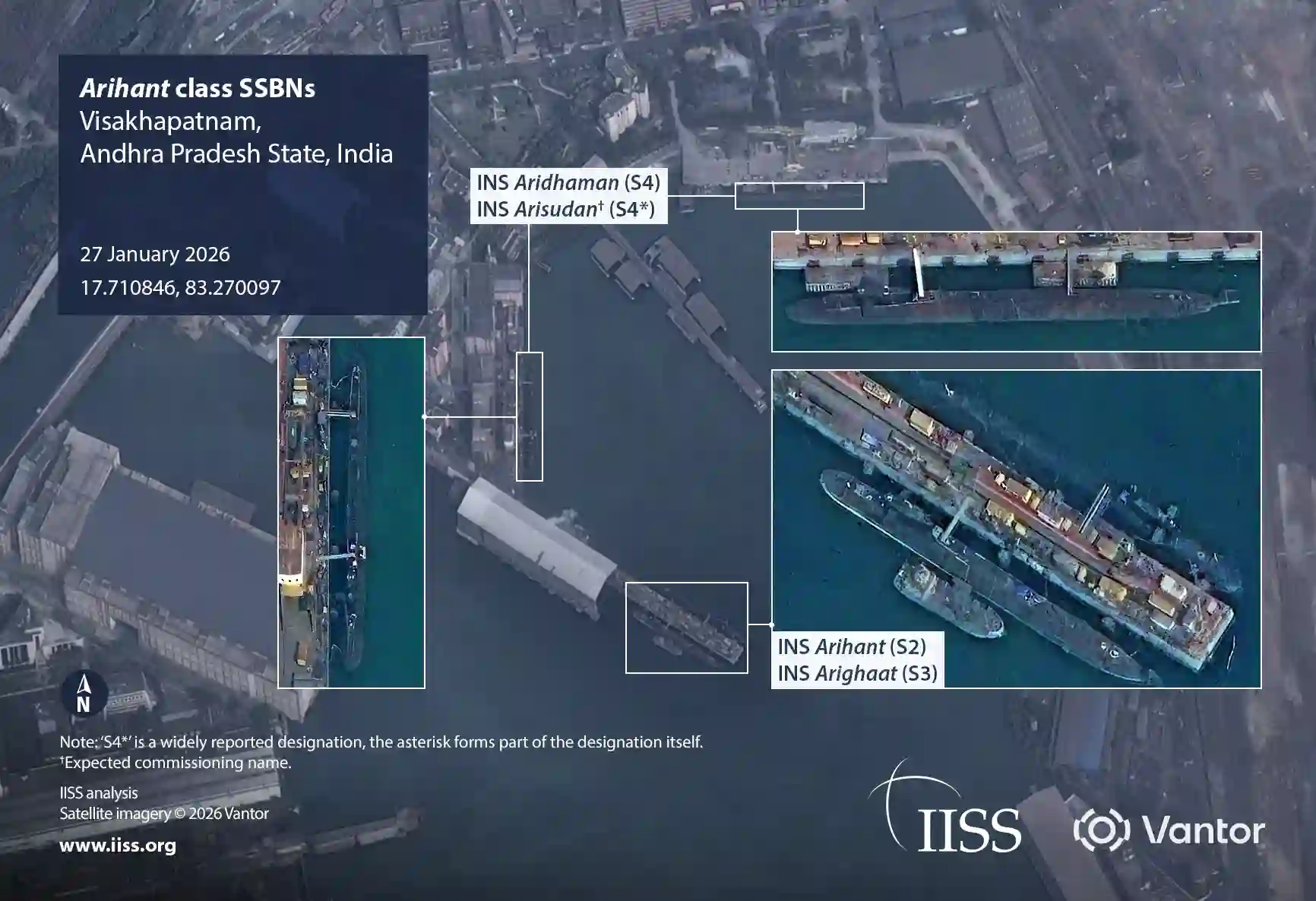
According to an analysis by the International Institute for Strategic Studies (IISS), satellite imagery from January 2026 reportedly showed all Arihant-class submarines positioned together at Visakhapatnam.
That includes:
- INS Arihant
- INS Arighaat
- INS Aridhaman
- And the upcoming S4* submarine is expected to become INS Arisudan.
Very few countries openly expose this level of submarine visibility.
And that is exactly what has surprised many defence observers.
These submarines are not ordinary military assets.
They are India’s final nuclear shield.
Why Nuclear Submarines Are So Important
India’s nuclear defence system works through three major layers:
1. Land-Based Nuclear Missiles
These include long-range ballistic missiles launched from land platforms.
2. Air-Delivered Nuclear Weapons
Fighter aircraft and bombers capable of carrying nuclear payloads.
3. Sea-Based Nuclear Deterrence
Nuclear submarines carrying ballistic missiles underwater.
Of the three, submarines are considered the most survivable and strategically important.
Why?
Because they can remain underwater for weeks or even months without detection.
Even if enemy missiles destroy land launch systems and airbases, hidden submarines can still retaliate.
This is known as a second-strike capability.
And this capability is what prevents nuclear war in the first place.
Countries like:
- the United States
- Russia
- China
- France
- and the United Kingdom
All maintain nuclear submarines on continuous underwater patrol.
This strategy is known as:
Continuous At-Sea Deterrence (CASD)
The logic is simple:
“A nuclear submarine is powerful only when nobody knows where it is.”
And this is where the real debate begins.
India’s Arihant-Class Nuclear Submarine Fleet
India’s nuclear submarine fleet has expanded steadily over the past decade. Each submarine represents a major technological and strategic milestone for the Indian Navy.
INS Arihant
INS Arihant is India’s first indigenous nuclear-powered ballistic missile submarine and the foundation of the country’s sea-based nuclear deterrence. The submarine completed its first deterrence patrol in 2018 and marked India’s entry into the elite group of nations operating SSBNs.
Arihant carries K-15 and K-4 submarine-launched ballistic missiles and is designed to provide India with a second-strike capability during a nuclear conflict. Despite being smaller than many global SSBNs, INS Arihant remains one of India’s most strategically important defence assets.
INS Arighaat
INS Arighaat is the second Arihant-class nuclear submarine and an upgraded version of INS Arihant. The submarine reportedly features improved stealth, operational systems, and missile deployment capability.
Arighaat represents India’s effort to strengthen continuous underwater deterrence and reduce dependence on a single operational SSBN. Defence analysts believe the submarine plays a crucial role in helping India move closer to maintaining a continuous nuclear patrol capability. It also reflects the Indian Navy’s growing experience in operating indigenous nuclear-powered submarines.
INS Aridhaman
INS Aridhaman, reportedly commissioned in April 2026, is India’s third operational nuclear-powered ballistic missile submarine. Unlike earlier submarines, Aridhaman is believed to feature a larger design and increased missile carrying capability.
Reports suggest the submarine includes eight vertical launch tubes instead of four, allowing it to carry more long-range ballistic missiles. The submarine’s induction marks another major step in India’s sea-based nuclear deterrence strategy. However, its visibility in recent satellite imagery has also intensified concerns regarding operational secrecy and deployment patterns.
INS Arisudan
India’s fourth Arihant-class submarine, currently known as S4* and expected to be named INS Arisudan, is presently undergoing sea trials. The submarine is expected to further improve India’s underwater nuclear capability and help reduce operational pressure on existing submarines.
Analysts believe INS Arisudan could help India move closer toward maintaining continuous underwater nuclear patrols. The submarine is also expected to feature advanced missile capability, larger displacement, and better endurance compared to the earlier Arihant-class boats.
Read More: K‑6 Hypersonic Missile: India’s Mach 7.5 SLBM
Why Experts Are Suddenly Worried
The biggest issue is not that India has nuclear submarines.
The concern is that all of them were reportedly visible together at one naval location.
And this is where the strategic concern becomes serious.
Modern warfare is no longer limited to soldiers and missiles.
Today:
- satellites watch continuously,
- naval movement is tracked,
- deployment cycles are analysed,
- and military patterns are studied in real time.
If international analysts using commercial satellite imagery can identify submarine activity, then countries like China almost certainly possess much deeper surveillance capabilities already.
And that changes the conversation completely.
Could China Already Be Tracking India’s Nuclear Submarines?
This is now one of the biggest questions being discussed online.
China operates one of the world’s most advanced military satellite networks and has significantly expanded its surveillance presence across the Indian Ocean region.
Pakistan also closely monitors Indian naval activity because of ongoing regional tensions.
Modern surveillance systems can identify:
- dock activity,
- submarine support movement,
- infrastructure expansion,
- and even deployment timing patterns.
This does not mean India’s submarines are defenceless.
But it does highlight a harsh reality:
Military secrecy is becoming harder than ever.
And when nuclear submarines are involved, even small operational exposure becomes a national security discussion.
Because deterrence depends not only on strength, but also on uncertainty.
What Happens If Conflict Breaks Out Suddenly?
This is the question many defence analysts quietly ask.
In a real military crisis, nuclear submarines are expected to:
- already be underwater,
- remain hidden,
- and guarantee retaliation capability.
Critics argue that if multiple submarines are concentrated at one location during peacetime, adversaries may gain valuable intelligence about:
- deployment routines,
- operational readiness,
- maintenance cycles,
- and response timing.
Some experts believe India now needs faster progress in:
- permanent underwater patrol cycles,
- submarine dispersal,
- hardened infrastructure,
- and operational secrecy.
Others argue this situation may simply reflect maintenance and training activity inside a still-maturing submarine fleet.
But regardless of the explanation, one thing is clear:
The era of invisible military infrastructure is slowly disappearing.
INS Varsha Could Become India’s Most Important Naval Facility
INS Varsha
India appears fully aware of these risks.
To improve secrecy and survivability, the country is constructing INS Varsha — a massive underground submarine facility near Rambilli in Andhra Pradesh.
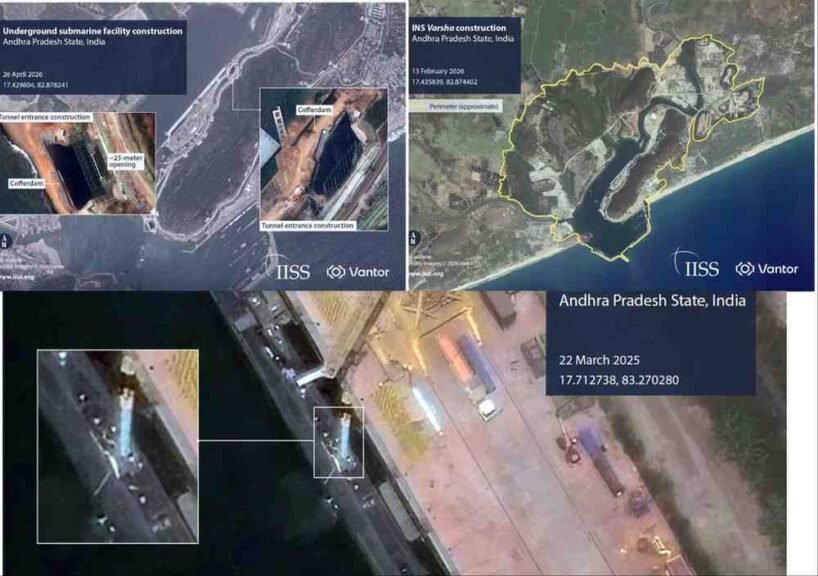
The upcoming base reportedly includes:
- underground submarine tunnels,
- hidden docking chambers,
- secure operational infrastructure,
- and protected submarine shelters.
The objective is clear:
- reduce satellite visibility,
- improve survivability,
- and protect submarines during conflict.
This type of underground submarine infrastructure is already used by China and other major military powers.
Once operational, INS Varsha could become one of India’s most strategically important defence facilities.
Bigger Missiles, Bigger Stakes
India’s newest submarines are also becoming significantly more advanced.
The newer Arihant-class submarines reportedly feature:
- 8 missile launch tubes instead of 4,
- larger hull structures,
- and longer-range missile capability.
India’s submarine-launched ballistic missile systems include:
- K-15 Sagarika
- K-4 ballistic missile with a range of nearly 3,500 km
The K-4 missile allows Indian submarines to launch strikes from safer waters deep inside the Indian Ocean.
This dramatically improves survivability and strategic reach.
Why This Matters for Every Indian
Very few people discuss submarine strategy outside defence circles.
But these submarines protect India during the worst possible national security scenarios.
They are designed to ensure that even after a devastating attack, India can still respond.
That capability itself prevents war.
Which is why questions around:
- deployment secrecy,
- underwater patrol readiness,
- and satellite visibility
have now become so important.
Because in modern warfare, visibility can become vulnerability.
And when a country’s final nuclear shield becomes visible from space, the questions become impossible to ignore.