
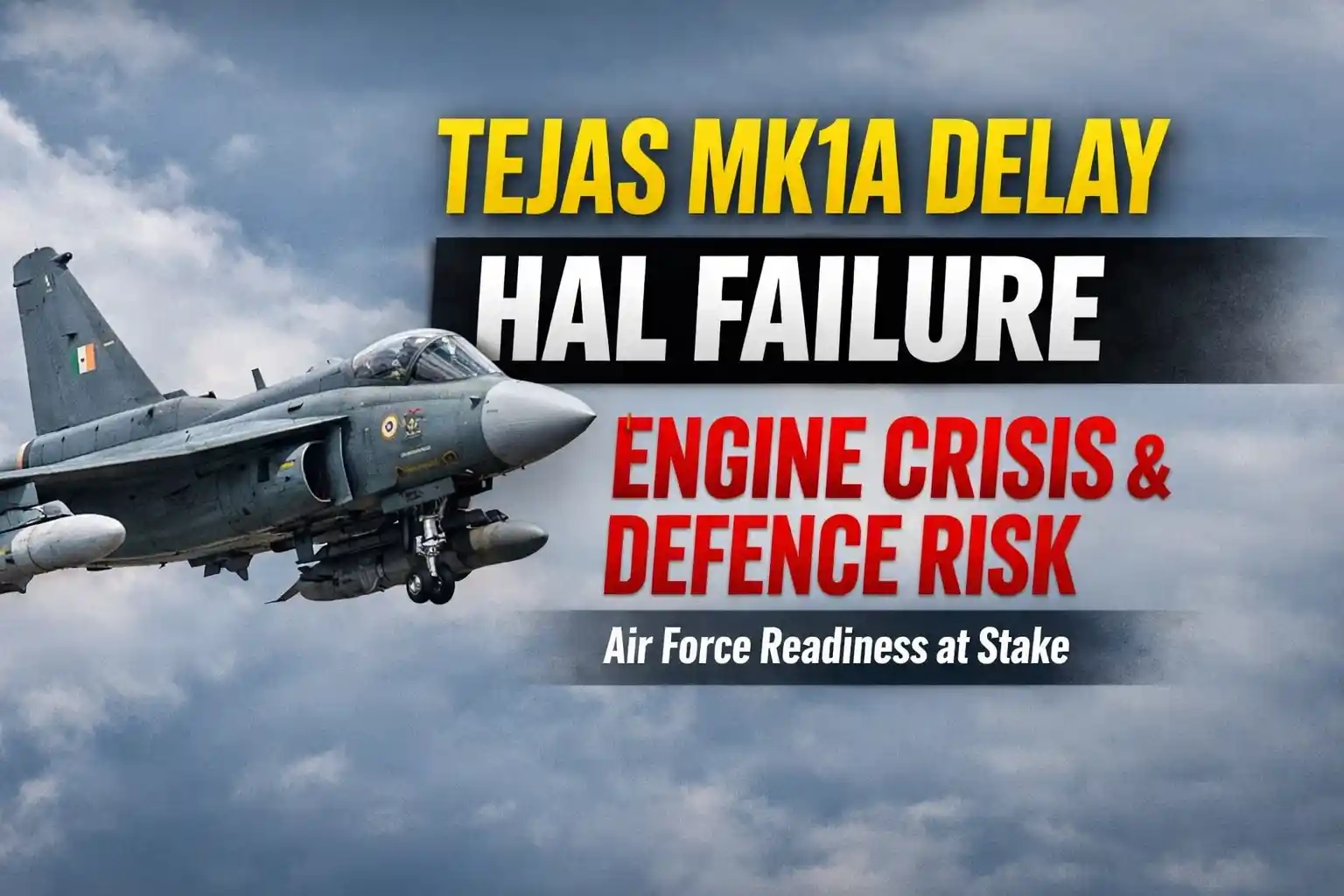
Tejas Mk1A delay is not merely a production setback; it reflects a deeper structural issue in India’s defence manufacturing system. Hindustan Aeronautics Limited (HAL), as the prime integrator, is responsible for delivering these aircraft.
Yet the programme has slowed due to engine supply constraints and planning gaps. At a time when the Indian Air Force faces declining squadron strength, this delay raises serious questions about accountability, execution capability, and the long-term reliability of India’s defence production framework.
A Programme with a Long History of Delays
The Tejas programme itself has been shaped by delays over several decades.
- Development began in the 1980s
- Initial operational induction took far longer than expected
- The Mk1A variant was intended to streamline production and accelerate delivery
The purpose of Tejas Mk1A was clear: to avoid repeating past delays and to ensure faster induction into the Indian Air Force.
However, the current delay suggests that underlying structural issues have not been fully resolved. Instead of representing a shift toward efficiency, the Mk1A programme appears to be facing familiar challenges—dependency, execution gaps, and delivery slippages.
Expectation vs Reality: The Data Gap
A closer look at the numbers reveals the scale of the problem.
- Aircraft ordered: 83
- Contract signed: 2021
- Engines delivered: only 6 as of early April 2026
- Required squadron strength: approximately 42
- Current strength: around 30–32
This mismatch between expectation and reality is significant.
Even with production infrastructure in place, the programme cannot move forward at the required pace due to limited engine availability. This creates a widening gap between planned induction and actual capability.
97 Additional Tejas Mk1A Jets: Historic ₹62,000 Cr Deal
Engine Dependency: The Immediate Bottleneck
The most visible cause of the Tejas Mk1A delay is the shortage of GE F404-IN20 engines.
As of early April 2026, reports indicate that only six engines have been delivered, including the most recent unit. This is well below the number required to sustain a steady production and delivery schedule.
The impact of this shortfall is direct:
- Aircraft cannot be completed without engines
- Final delivery timelines are delayed
- Production planning is disrupted
This highlights a critical reality: even if airframes are ready, the absence of engines prevents aircraft from being inducted into service.
HAL received the third GE-404 engine for Tejas
Beyond Supply: The Risk of External Dependency
While the engine shortage is immediate, the larger issue is dependency.
The Tejas Mk1A programme relies on a single external supplier for a critical component. This creates multiple risks:
- Lack of alternative sourcing options
- Limited control over delivery timelines
- Exposure to external industrial and geopolitical factors
When a defence programme depends on external supply for core systems, delays are not just possible; they are likely.
Even if delays are not intentional, the outcome remains the same: reduced control over national defence timelines.
HAL Accountability: The Central Question
It is important to recognise that while engine delays originate externally, accountability for programme delivery cannot be fully shifted.
HAL, as the prime integrator, is responsible for:
- Managing supplier dependencies
- Planning for foreseeable risks
- Ensuring delivery timelines are met
The dependence on imported engines was known from the beginning. This makes the current situation less about unforeseen disruption and more about insufficient risk mitigation.
Failure to Anticipate Risk
The absence of strong contingency measures raises important concerns:
- No visible alternate sourcing strategy
- No effective buffer planning
- Limited evidence of fallback mechanisms
A known dependency has effectively become the primary cause of delay.
Over-Reliance Without Safeguards
Strategic defence programmes require resilience. They must be designed to handle disruptions without halting progress.
In this case, reliance on a single supplier has created a single point of failure. When that supplier faces delays, the entire programme slows down.
This reflects a gap in planning, not just execution.
Organisational and Structural Concerns
The Tejas Mk1A delay also highlights broader issues within the defence production system.
Execution and Process Challenges
Large-scale public-sector programmes often face:
- Slower decision-making processes
- Multiple layers of approval
- Limited operational flexibility
These factors can reduce the speed and responsiveness required in defence manufacturing.
Accountability and Performance Culture
Another critical issue is how performance is evaluated.
- Delays do not always result in strict accountability
- Programme timelines may not be tightly enforced
- Execution efficiency may not be prioritised
This creates an environment where delays become easier to absorb rather than resolve.
Impact on Indian Air Force Readiness
The consequences of the Tejas Mk1A delay are already visible.
Squadron Strength Gap
The Indian Air Force operates below its required strength:
- Required: ~42 squadrons
- Current: ~30–32
This gap affects operational planning and readiness.
Delayed Replacement of Legacy Aircraft
Aircraft such as the MiG-21 are being phased out. The Tejas Mk1A was intended to replace these platforms and restore strength.
However, delays in delivery mean:
- Replacement is slower than retirement
- Capability gaps continue to widen
Operational Consequences
- Reduced combat readiness
- Increased pressure on the existing fleet
- Slower modernization
Every delayed aircraft directly affects India’s air power capability.
First Tejas Mk1A Delivery: HAL Nashik Facility Receives Flight Clearance
A Larger Question: Is the Defence Production Model Adequate?
The Tejas Mk1A delay raises a broader question about the structure of defence manufacturing in India.
- Why is a single public-sector entity responsible for multiple critical programmes?
- Why is private-sector participation limited in core production?
- Why are delivery timelines not enforced with stricter accountability?
A more diversified ecosystem could:
- Improve efficiency
- Introduce competition
- Reduce dependency risks
This is not about replacing HAL. It is about strengthening the overall system.
Conclusion
The Tejas Mk1A delay is not just a temporary disruption. It reflects deeper challenges in planning, execution, and dependency management within India’s defence manufacturing system. While the engine shortage is the immediate bottleneck, it also highlights how a known dependency was not adequately mitigated.
HAL, as the programme lead, must be held accountable for managing these risks and ensuring delivery commitments are met. At the same time, the broader system must evolve to improve resilience and reduce dependency.
In defence, time is a critical resource. Delays are not just operational setbacks—they are strategic risks that directly impact national security.