
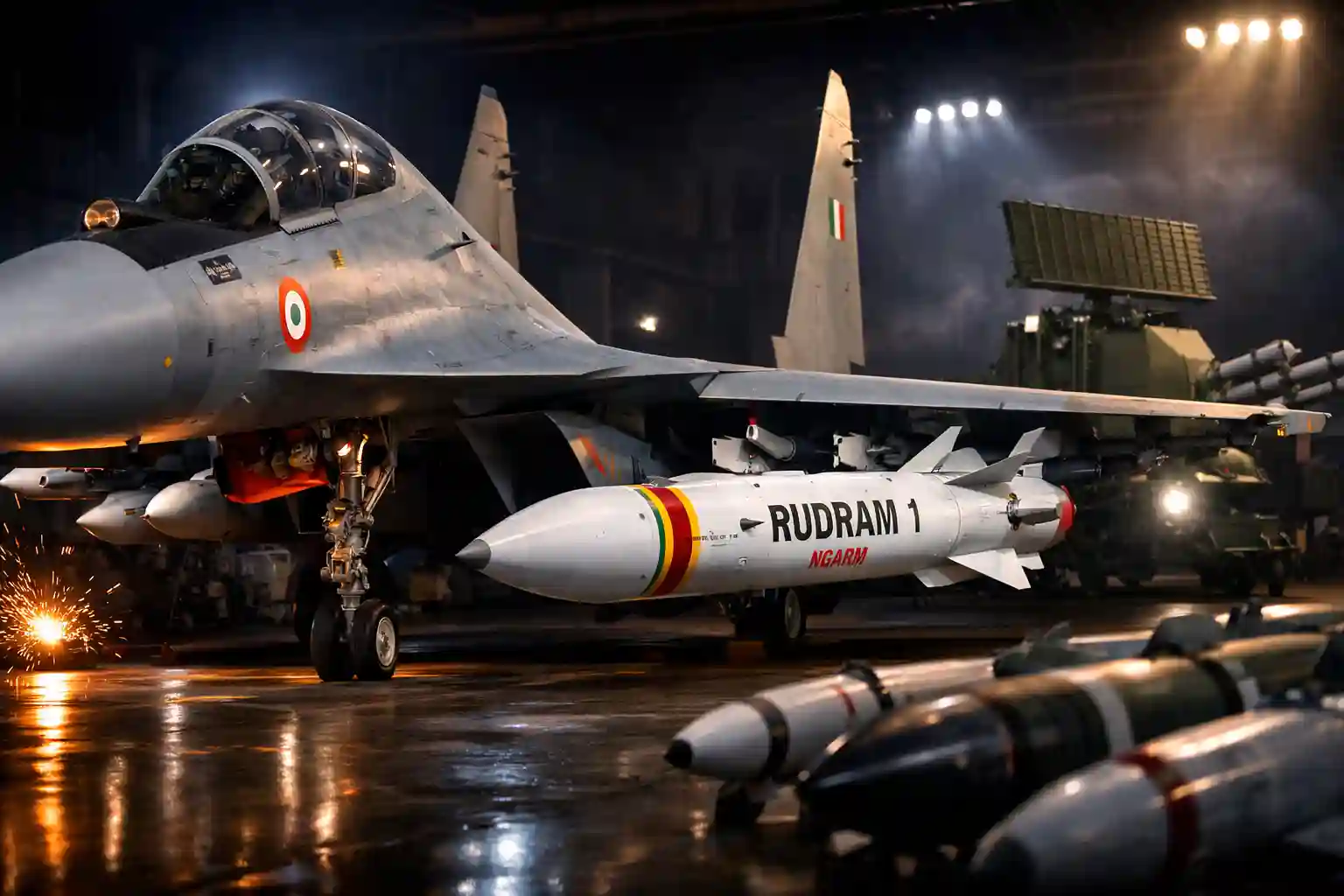
Across India’s missile test ranges and frontline air bases, a critical capability shift is quietly unfolding. The Indian Air Force and DRDO are engaged in focused discussions for large orders of the 200 km-class Rudram 1 NGARM, India’s indigenous anti-radiation missile built for SEAD missions.
This moment matters because long-range stand-off weapons decide air superiority in modern conflicts. A production push for Rudram 1 would firmly anchor India’s indigenous SEAD capability and redefine the opening phase of future air operations.
What Rudram 1 NGARM Is and Why It Matters
Rudram 1, also known as the Next Generation Anti-Radiation Missile, is India’s first indigenous air-launched weapon specifically designed to destroy hostile radar systems. Anti-radiation missiles are crucial for SEAD operations, enabling strike aircraft to operate within contested airspace with reduced risk.
For the Indian Air Force, Rudram-1 fills a long-standing capability gap by providing a domestically controlled radar-seeking missile tailored to Indian operational doctrine. Its induction strengthens India’s ability to neutralise enemy surface-to-air missile networks, early-warning radars, and fire-control systems during the initial phase of a conflict.
Explore: Rudram 4 Missile: India’s 1000km Hypersonic Game-Changer
Development Background and Programme Status
The Rudram programme is led by the Defence Research and Development Organisation as part of India’s wider push for indigenous missile development.
Key milestones
- Successful flight test conducted in October 2020
- Accurate passive radar homing demonstrated
- Integration completed on the IAF Su-30MKI aircraft
- Ongoing refinements based on user feedback
The current IAF–DRDO discussions indicate that Rudram-1 is approaching readiness for serial production, a stage reached only after confidence in performance, reliability, and operational suitability.
Also Read: Indian Navy’s Boeing P-81 with Rudram-II: Game Changer
Design Philosophy and Guidance Architecture
Rudram 1 NGARM is engineered to defeat modern, adaptive air defence networks.
Core design features
- INS/GPS mid-course guidance for long-range navigation
- Passive Homing Head to lock onto radar emissions
- Ability to engage radars even after shutdown attempts
- Optimised for high-speed, high-altitude launch profiles
This guidance architecture ensures effectiveness against frequency-agile radars and electronic countermeasures, positioning Rudram-1 as a credible next-generation anti-radiation missile.
Key Specifications and Performance Envelope
While official specifications remain classified, open-source data outlines the missile’s operational profile.
Known capability indicators
- Range: up to ~200 km, depending on launch parameters
- Primary role: Anti-radiation and SEAD missions
- Launch platform: Su-30MKI, with scope for other fighters
- Warhead: High-explosive, pre-fragmented design
- Guidance: INS/GPS with passive radar homing
The extended range places Rudram-1 firmly in the long-range anti-radiation missile category, enabling stand-off attacks beyond hostile air defence envelopes.
Why the 200 km Range Is a Game Changer for SEAD
Range is the decisive factor in SEAD missions. A 200 km-class anti-radiation missile allows the Indian Air Force to strike enemy radars while remaining outside dense SAM coverage.
Operational advantages
- Stand-off launch from safe distances
- Reduced the exposure of high-value fighter aircraft
- Early neutralisation of surveillance and fire-control radars
- Greater flexibility during mission planning
This capability aligns the IAF with global best practices in modern SEAD warfare.
Role Within India’s Indigenous Defence Ecosystem
Rudram-1 represents a key achievement under India’s Atmanirbhar Bharat defence initiative.
Strategic benefits
- Replacement of imported anti-radiation missiles
- Secure domestic supply chains during crises
- Faster upgrades without foreign approvals
- Seamless integration with Indian sensors and networks
For the IAF, indigenous control over SEAD weapons enhances operational sovereignty and long-term readiness.
Operational Mission Scenarios
In real-world combat, Rudram-1 would be deployed during the opening phase of air operations.
Typical SEAD employment profile
- Su-30MKI fighters launch Rudram-1 from stand-off range
- Missile homes in on hostile radar emissions
- Radar destruction opens corridors for strike aircraft
- Enemy air defence coordination degrades rapidly
This makes Rudram 1 a true force multiplier, rather than a niche weapon.
Path to Production, Induction, and Future Growth
The ongoing IAF–DRDO talks focus on order quantities, production timelines, and sustainment planning.
Bulk procurement would:
- Enable economies of scale in missile production
- Accelerate induction across multiple IAF squadrons
- Support the development of extended-range variants
Rudram 1 is expected to be the first member of a broader indigenous anti-radiation missile family, strengthening India’s long-term SEAD posture.
Final Thoughts
The discussions between the Indian Air Force and DRDO on 200 km Rudram 1 NGARM orders reflect a decisive shift in India’s air combat doctrine. This is not merely about replacing imports. It is about owning the first move in contested airspace.
As Rudram-1 moves closer to large-scale induction, India strengthens its indigenous SEAD capability, ensuring that future air campaigns begin on Indian terms, powered by Indian technology.