

Drones are rewriting the rules of modern warfare. In Ukraine, swarms of cheap UAVs have overwhelmed billion-dollar defence systems. In the Middle East, they have struck critical oil facilities with precision. By 2025, more than 100 nations will have invested in this battlefield technology. For India, where cross-border drone intrusions are a growing reality, the danger is urgent.
To counter this threat, DRDO is developing the DRDO high power microwave weapon, a key part of its HPEM anti-drone system India program. This drone-mounted HPEM payload represents a breakthrough in directed energy weapon capabilities.
What Is the HPEM Anti-Drone System in India?
The HPEM anti-drone system India is working on represents a leap in directed energy weapons. Instead of firing a missile or bullet, it emits a burst of high-power electromagnetic energy that fries a drone’s electronics within seconds. The UAV’s controls are disrupted, its circuits overloaded, and it is forced out of the sky without a single shot being fired.
For example, if a hostile UAV approaches a strategic airbase, a microwave burst from this system can disable it within seconds. This eliminates the need for expensive interceptors and avoids collateral damage.
Also Read: India’s 30-kW Directed Energy Weapon: Sahastra Shakti 2025
Drone-Mounted HPEM Payload: The Next Frontier
One of the most promising aspects of this project is the drone-mounted HPEM payload. By integrating the payload onto UAVs, India can create airborne hunters that track and disable enemy drones in real time.
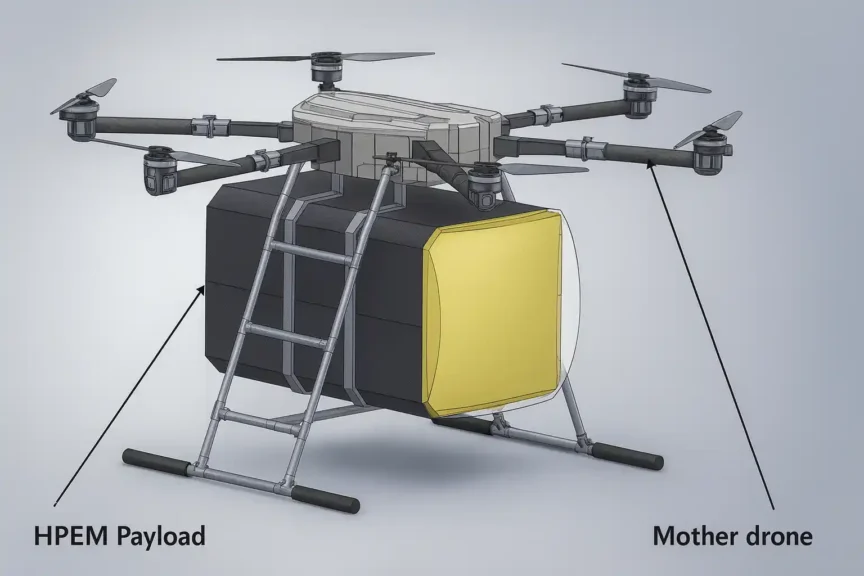
Key features include:
- Wideband design to disrupt multiple frequencies at once.
- Compact, man-portable form factor suitable for integration on various UAV platforms.
- Non-kinetic neutralisation without explosive destruction.
This capability adds flexibility and mobility to the DRDO anti-drone technology 2025 roadmap and could allow India to deploy anti-drone defences wherever needed.
Related: Understanding India’s 300 kW Surya Laser Weapon System (DEWs)
Directed Energy Weapon India: Joining the Global League
Across the world, directed energy systems are moving from experimental labs to frontline deployment.
- The United States has field-tested the THOR microwave weapon to counter UAV swarms.
- Private firm Epirus has introduced the Leonidas system, noted for its software-driven targeting.
- China has unveiled truck-mounted microwave platforms as part of its layered air defence network.
Against this backdrop, the directed energy weapon India is developing allows DRDO to stand alongside these global leaders. What sets India apart is its bold focus on miniaturisation, creating an HPEM payload compact enough to be mounted on drones.
If successful, it could shift the role of directed energy from bulky ground systems to agile aerial platforms, a capability only a handful of nations are even attempting today.
DRDO Anti-Drone Technology 2025: Toward Layered Defence
India’s future anti-drone defence will not rely on a single weapon but on a layered system. The vision includes:
- Laser systems for precision targeting.
- Surface-to-air missiles for large UAVs and cruise missiles.
- Electronic jammers to disrupt communications.
- The microwave weapon system India is building to disable entire swarms at minimal cost.
This balance ensures both effectiveness and efficiency. Using a missile worth several crores against a drone worth a few lakhs is unsustainable. Microwave bursts provide a cost-effective alternative.
Cost Comparison: Why HPEM Is Smarter
| Weapon Type | Cost per Shot | Best Use Case | Limitation |
|---|---|---|---|
| Missile (SAM) | ₹2–5 crore | Large drones, cruise missiles | Too costly for small UAVs |
| Laser Weapon | ₹5–10 lakh | Single drone, precision strike | Limited to line of sight |
| Electronic Jammer | Very low | Disrupting links | Ineffective against autonomous drones |
| HPEM Weapon | Negligible | Drone swarms, multiple UAVs | Requires a high-power source |
This comparison highlights why the DRDO counter-drone weapon could be India’s most practical and scalable defence against drone warfare.
High Power Electromagnetic Payload: India’s Innovation Edge
The high-power electromagnetic payload that DRDO is developing is designed to be modular, scalable, and compact. Unlike most global HPEM systems, which remain bulky and confined to truck-mounted platforms, India’s effort focuses on building a system light enough for UAV integration.
If this goal is achieved, Indian drones could patrol sensitive border zones carrying the HPEM payload, ready to disable intruding UAVs long before they reach strategic bases or civilian areas. Such mobility would give India a unique defensive edge, turning its UAV fleet into both scouts and electronic warriors.
DRDO High Power Microwave Weapon: Development Timeline
- 2025: Prototype design accelerated by DRDO.
- 2026: Initial trials with medium UAV platforms.
- 2027–28: Field testing in sensitive border regions such as Punjab, Jammu, and Rajasthan.
- 2030: Expected operational induction into India’s layered air defence network.
This timeline shows how India could move from concept to deployment of HPEM drone-mounted weapons within the decade.
Why the DRDO High Power Microwave Weapon Matters for India
The DRDO high-power microwave weapon is not just a new project but a statement of intent. It signals India’s transition from relying on imported solutions to shaping the future of indigenous defence technology.
The hurdles are significant, from building a compact power source to ensuring stability in real-world combat environments. But once operational, this system could become one of the world’s most cost-effective anti-drone solutions, capable of neutralising swarms that even advanced militaries struggle against.
From my perspective, this weapon is not only about defeating drones. It embodies self-reliance, technological confidence, and the true spirit of Atmanirbhar Bharat.
Key Takeaways
- The DRDO high-power microwave weapon is India’s latest counter to drone threats.
- The HPEM anti-drone system India uses electromagnetic energy to disable UAVs.
- A drone-mounted HPEM payload offers mobile defence against swarms.
- Part of India’s directed energy weapon push to join global leaders.
- Fits into the DRDO anti-drone technology 2025 roadmap for layered defence.
- The microwave weapon system India provides cost-effective protection.
- The DRDO counter-drone weapon boosts Atmanirbhar Bharat efforts.
- Compact high-power electromagnetic payloads can secure India’s skies.
FAQs
Q1. What is the DRDO high-power microwave weapon?
It is a directed energy system that disables drones using powerful microwave bursts.
Q2. How does the HPEM anti-drone system in India work?
It fries drone electronics with electromagnetic pulses, making them crash instantly.
Q3. What is the use of a drone-mounted HPEM payload?
It allows Indian UAVs to hunt and neutralise enemy drones in the air.
Q4. Why is the microwave weapon system in India cost-effective?
Because it neutralises multiple drones at negligible cost per shot compared to missiles.
Q5. When will DRDO’s anti-drone technology 2025 be ready?
Field trials are expected by 2026, with induction likely by 2030.
Q6. Is the DRDO counter-drone weapon part of Atmanirbhar Bharat?
Yes, it is being developed indigenously under India’s Atmanirbhar Bharat defence programme.