
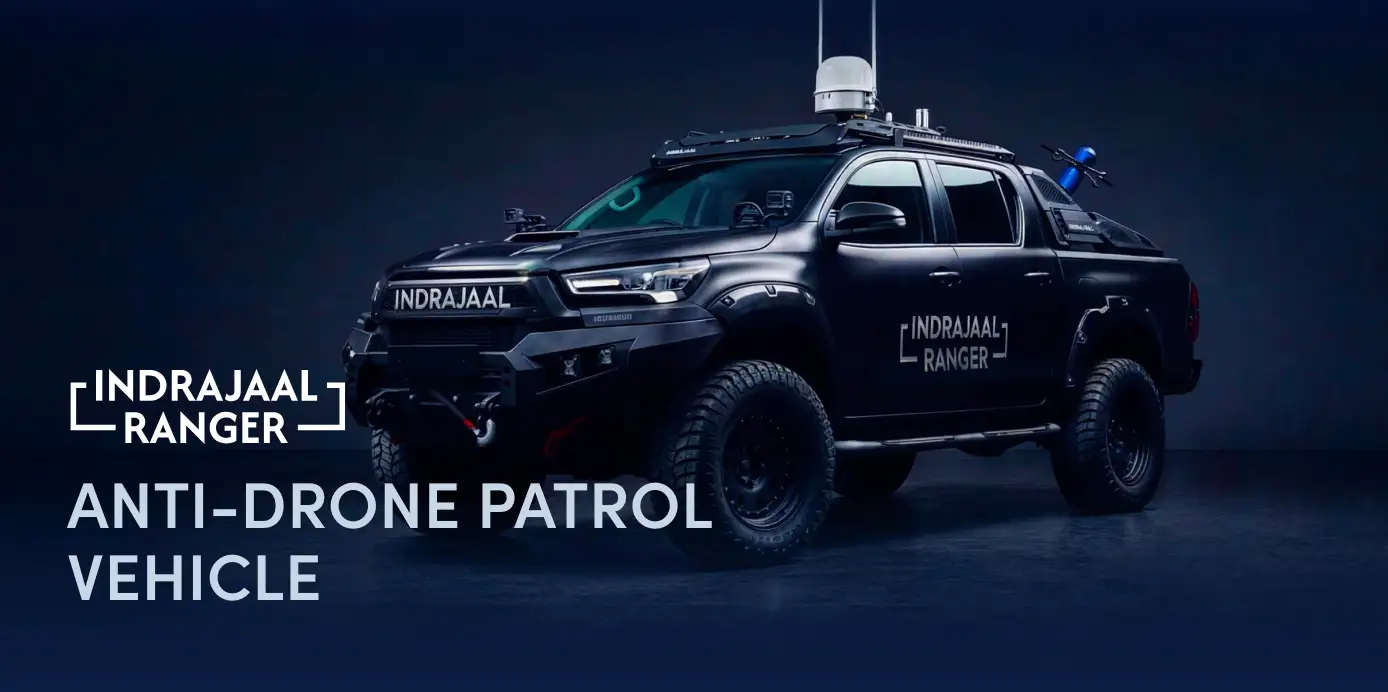
The border plains fall silent as dusk settles and a futuristic vehicle moves forward with intent. Its radar rotates, sensors sweep the sky, and an advanced AI core evaluates every signal in real time.
This is the Indrajaal Ranger, introduced as India’s first fully mobile, AI-enabled Anti-Drone Patrol Vehicle, designed to counter rising UAV threats across borders and cities.
It represents a powerful moment for India’s private defence innovation and a major step toward protecting airspace from modern drone incursions.
What Indrajaal Ranger Is and Why It Matters
Indrajaal Ranger aims to tackle modern drone threats that fixed anti-drone systems struggle to manage. UAV incidents have risen sharply, demanding mobile solutions that adapt to shifting danger zones.
Why is this system important?
- India faces increasing drone drops, surveillance UAVs and cross-border smuggling
- Static systems cannot chase moving drones
- A mobile platform increases coverage, response speed and threat interception accuracy
Development Background
Indrajaal Ranger was designed, developed and manufactured by Hyderabad-based defence-tech company Indrajaal Drone Defence, a private Indian firm specialising in rapid innovation across Counter-UAS and AI-driven security systems.
Unveiled publicly in 2025, it gained significant media attention for its futuristic architecture, mobility-first engineering and autonomous AI threat-response capabilities.
Key development facts
- Built on a 4×4 all-terrain chassis
- Designed for border, desert, urban and mountainous zones
- Reflects India’s shift toward private-sector defence innovation
- Intended to complement existing fixed anti-drone systems
India’s Best Drone Killer: Zen ADS HK: India’s Drone Killer Unleashed
Design Philosophy and Architecture
Ranger is engineered around three principles: mobility, AI-driven autonomy and layered counter-drone tools.
Mobility-first design
- Operates efficiently on border roads, farmlands and urban lanes
- Can reposition quickly when drone hotspots shift
- Provides high-coverage patrolling and surveillance
AI-powered intelligence
- SkyOS AI engine detects, identifies and prioritises threats
- Predictive modelling improves interception accuracy
- AI reduces operator workload during high-stress drone incidents
Integrated sensor fusion
- Compact radar for long-range tracking
- RF sensors to detect drone communications
- EO/IR cameras for day-night imaging
- Electronic warfare modules for jamming & spoofing
India’s Low-Cost Drone Killer Missile: Inside India’s New Low-Cost Anti-Drone Missiles
Key Specifications (Manufacturer Claims)
Ranger presents ambitious performance metrics that, if validated, would significantly expand India’s drone-defence options.
Detection
- Range: 10 km
- 360-degree scanning
- Sensor fusion to reduce false alarms
Neutralisation
- Range: 4 km
- Jamming, GNSS spoofing and cyber takeover
- Designed for soft-kill, safe in civilian areas
Vehicle
- 4×4 all-terrain chassis
- Modular architecture for upgrades
- High endurance for long patrol routes
Soft-Kill Advantage
Unlike gun- or missile-based counter-UAS systems, Ranger uses soft-kill tools that minimise collateral damage.
Why soft-kill is safer
- No debris falling on civilians
- No risk to aircraft or crowded areas
- Works near airports, cities and public gatherings
- Effective against small and low-altitude UAVs
India’s Advanced Drone Killer System: VyomKavach CUAS: India’s Advanced Anti-Drone Defence
Role in India’s Security Ecosystem
India faces multiple types of drone threats across diverse regions. Ranger’s mobility makes it suitable for all of them.
Western Border (Pakistan side)
- Counters narcotics drops, weapon drops and surveillance UAVs
- Patrols border roads to intercept drones before deep intrusion
Northern / Northeastern Fronts
- Overcomes terrain limitations that affect fixed systems
- Can operate across valleys and mountainous regions
Urban and Critical Infrastructure
- Ideal for airports, government zones, sports events and large gatherings
- Soft-kill tools make it safe for densely populated areas
What Is Confirmed and What Is Not
Maintaining credibility is essential. This section clarifies what is known and what remains unverified.
Confirmed
- Indrajaal Ranger has been officially launched
- Specifications have been publicly released
- The media has covered demonstrations
- The system is marketed as deployment-ready
Not Confirmed
- No verified Indian Army induction
- No Ministry of Defence procurement order
- No official field trial results
- No operational deployment images
- No independent performance evaluation
Global Counter-Drone Landscape and Where Ranger Stands
Modern battlefields are witnessing an explosion of low-cost drones, pushing nations to adopt faster and smarter counter-UAS solutions. Indrajaal Ranger positions itself within this global shift by offering a mobility-first, AI-driven architecture rarely seen in its category.
How Ranger compares internationally
- The US M-SHORAD uses hard-kill weapons that pose risks in crowded Indian environments.
- Israel’s Drone Dome is advanced but static, expensive and difficult to scale across long borders.
- China’s C-UAS systems are often trailer-based, limiting mobility in dense or narrow terrain.
- European platforms like SKYLOCK rely on multi-unit setups rather than a single integrated vehicle.
Where Ranger gains an edge
- Fully mobile all-terrain patrol platform
- AI-led threat detection instead of operator-heavy systems
- Safe soft-kill tools suitable for civilian zones
- Modular, upgrade-friendly architecture
- Lower cost potential through Indian manufacturing
This positions the Indrajaal Ranger as a credible, scalable alternative in the global counter-drone ecosystem.
Challenges Ahead
To move from prototype to operational deployment, Ranger must prove itself across rigorous conditions.
Performance tests must pass
- Drone swarm handling
- Electronic warfare resilience
- Detection of low-RCS UAVs
- Harsh weather environments
- Complex urban clutter
- Night operation reliability
Future Potential
If validated through defence trials, Ranger could support a wide range of forces and missions.
Possible future users
- Indian Army
- BSF, CRPF, State Police
- Airport security agencies
- Coastal defence units
- Event protection forces
Export opportunity
Many nations need affordable, mobile anti-drone vehicles, giving India potential for defence exports.
Final Thoughts
Indrajaal Ranger represents the growing strength of India’s private defence sector, combining mobility, artificial intelligence and counter-drone capability in a single platform. While still untested under official defence trials, it demonstrates the direction India’s counter-UAS strategy could take.
If its claimed capabilities hold up in real-world evaluations, Ranger could become a significant asset in securing India’s borders, cities and critical infrastructure against evolving drone threats.